How to Care for a Stromanthe Triostar
Stromanthe thalia 'Triostar' (syn. S. sanguinea)
Missouri Botanical Garden gives this plant three instructions and they are the whole job: the soil must never dry out, indoor plants need high humidity, and they want eastern windows. It adds the warning that goes with the third one: the foliage burns in direct sun, especially through a hot summer. People buy a Triostar for the pink, put it somewhere bright enough to keep the pink, and scorch it. The east window is the compromise that holds both.
The name on your label is out of date, and MOBOT says so on its own page: Stromanthe sanguinea is a synonym of Stromanthe thalia, which Kew now treats as the accepted name. ‘Triostar’ is the cultivar, so the full form is Stromanthe thalia ‘Triostar’. Missouri Botanical Garden gives the native range as Brazil. It belongs to Marantaceae, the prayer plant family, alongside the prayer plant itself and Calathea orbifolia, and that relationship predicts most of what goes wrong with it.
The family connection matters for one specific reason. Fluoride injury is documented across Marantaceae: Penn State names fluoride toxicity as a cause of tip burn on maranta, and NC State names fluoride in tap water as a cause of brown tips on Goeppertia orbifolia. Nobody has published it for Stromanthe by name, so treat this as an inference across close relatives, not a cited fact about this plant.
It is still the first thing I would change if a Triostar browned at the edges on tap water, because the alternative explanations cost more and work less often.
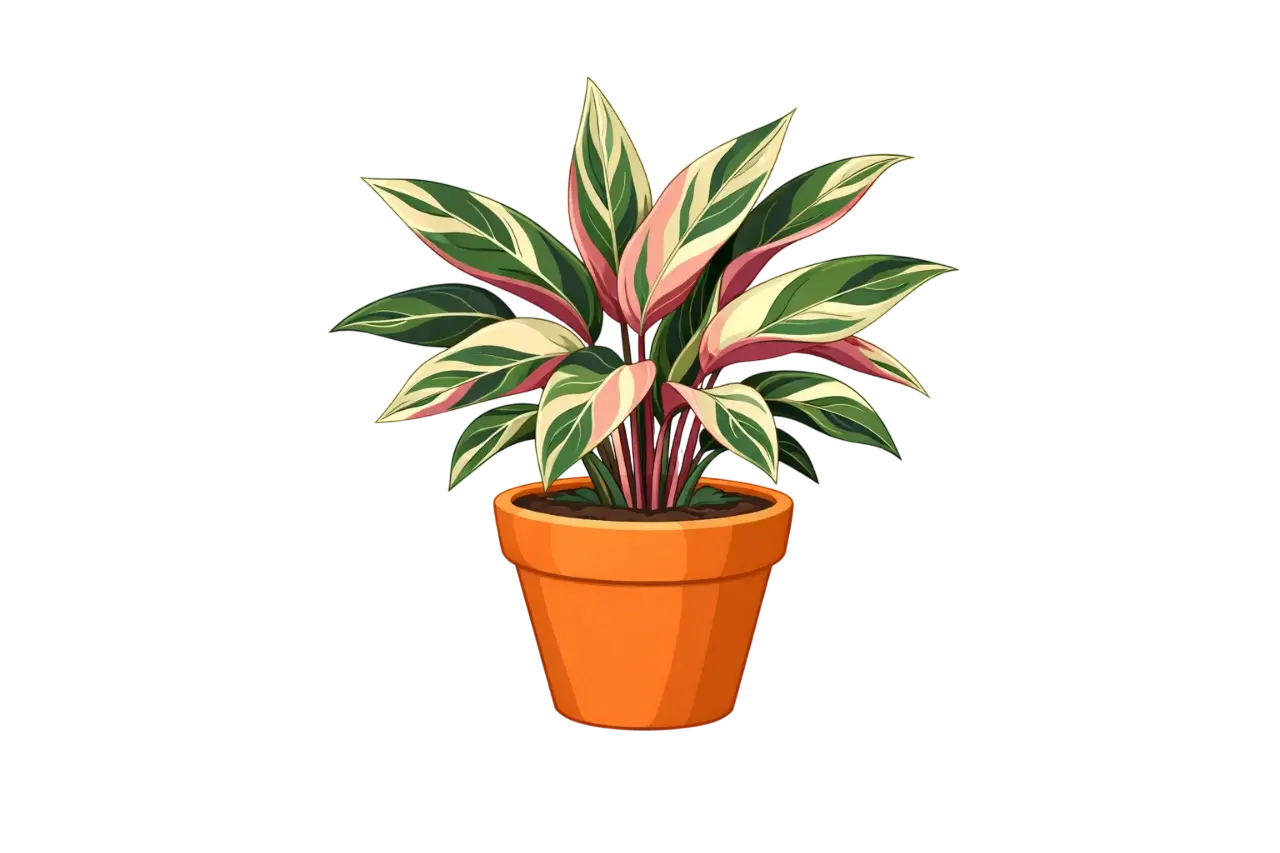
What you get in return is a plant that puts on a show twice a day. MOBOT describes dark olive-green leaves up to 20 inches long with red undersides that fold together at night, turning the whole plant over to magenta by evening. The variegation above is cream, green and pink in bands that differ on every leaf. It flowers in March and April, as tiny white flowers inside cherry red bracts, though the foliage is the reason anyone grows it.
Quick Info
- LightMedium
- WaterMedium
- Size2-3 feet tall and wide indoors
- HumidityHigh
- Temp65-80°F (18-27°C); no frost tolerance
- FloweringYes
- TypeTropical
- Dog SafeYes
- Cat SafeYes
- Kid SafeYes
Is Stromanthe Triostar Toxic to Pets?
Pets: Treated as safe, by family rather than by a species entry. The ASPCA lists Calathea spp. and the prayer plant as non-toxic to dogs, cats and horses, but has no Stromanthe entry of its own, and no toxic principle is on record for the genus. Nothing points at a hazard; the paperwork simply stops at the family.
Kids: No toxic principle is recorded for Stromanthe and no source reports irritant sap. Handling it is fine.
Stromanthe Triostar Care Guide
Light, and Holding the Variegation
MOBOT is unusually specific: eastern windows for indoor plants, and light or dappled shade outdoors. The reason for the precision is in its problems note, where foliage burns in direct sun, particularly during hot summers. An east window gives you a couple of hours of weak morning sun and bright shade for the rest of the day. That is the condition this plant is built for.
Too little light costs you the variegation, since cream and pink tissue has no chlorophyll to work with and the plant will favour green growth in a dim room. Too much bleaches and scorches what is already there. If your only option is a south or west window, set the plant well back from the glass or hang something sheer in front of it, and if your only option is a dark room, a grow light on a timer is more honest than hoping for the best.
Humidity, the Deciding Factor
MOBOT states plainly that indoor plants need high humidity, and this is the factor that decides whether a Triostar looks good or merely survives. Very few homes are anywhere close. Nebraska Extension gives 30 to 50 percent for a typical house, and Mississippi State has logged heated rooms at 10 to 30. A humidifier closes it where hoping does not.
The spray bottle is not a solution here. Nebraska Extension put a number on why: you would need to repeat it every few minutes to shift a room’s reading. On a plant MOBOT already lists for root and stem rot, regularly wet foliage is a poor trade. Group plants together if a humidifier is out of the question, and a bathroom with a window is a sound home for this one.
Watering, and the Water Itself
MOBOT puts it in four words: soil must never dry out. That is a stricter brief than most houseplants give you, and it rules out the water-when-you-remember approach entirely. Keep the compost evenly moist through the growing season and merely damp in winter, never waterlogged. A moisture meter earns its place on a plant with no tolerance at the dry end, because the top of the pot can feel dry while the root zone is fine, and the reverse.
The other end of the range still bites. MOBOT lists root and stem rot among the problems, so never means never-waterlogged as much as never-bone-dry. Water at the soil surface, let the excess run through, and empty the saucer. If a pot has already gone sour, yellowing leaves are usually the first sign that the roots, not the air, are the problem.
Rainwater or distilled water, for the family reason above. Fluoride accumulates in foliage instead of passing through, travelling up the transpiration stream and collecting at the leaf margins. That is where tip burn turns up on every Marantaceae plant anyone has studied for it. Fluoride sits in treated tap water at around one part per million.
One thing not to waste money on is a filter jug. Activated carbon handles chlorine and taste but leaves fluoride untouched, so filtered tap water browns the margins anyway. Standing water overnight off-gasses chlorine and leaves fluoride untouched. Rain and distilled are the two that work, and a Triostar is small enough that distilled water is a realistic habit.
Mix, and Not an Aroid Mix
MOBOT asks for fertile, moist but well-drained soil. The two halves of that are in tension on a plant whose compost must never dry out, so what you want is a mix that holds water without turning to sludge: an ordinary peat or coir-based houseplant compost, opened up slightly and not heavily drained.
Resist the urge to build a chunky aroid-style mix here. Bark and grit in quantity are right for a monstera and wrong for a Stromanthe, because they drain faster than the plant can cope with and you end up fighting to keep the moisture level MOBOT asks for. Good drainage in this case means the pot has a working hole, not that the mix is airy.
Temperature and Draughts
MOBOT puts the plant in USDA zones 10 to 12, which is another way of saying it has never met a frost. Ordinary room temperature suits it year round, and the thing to avoid is the swing, not any particular number: a cold draught from a door, or a windowsill behind a curtain on a freezing night. Beyond the zone rating the published record simply stops. Any specific indoor temperature band you find for Stromanthe was filled in by a writer rather than a horticulturist. What is sourced is the hardiness rating and the direct-sun warning, which between them describe a warm, bright, sheltered spot out of the beam.
Feeding, Lightly
A balanced liquid feed monthly through spring and summer covers it, stopping over winter when growth slows. MOBOT rates the plant’s maintenance as low and publishes no feeding schedule, so there is nothing elaborate to follow here.
Err on the weak side. A plant whose leaf margins are already the weak point does not need fertiliser salts accumulating in the compost, and the brown edges that overfeeding produces are indistinguishable at a glance from the humidity and water-quality browning you are trying to prevent. Flushing the pot with plain water every few months clears what has built up.
Repotting
Spring, every couple of years, or when roots start showing through the drainage holes. Step up one pot size. Growth spreads sideways from rhizomes, so a wider pot fills in more usefully than a deeper one, and repotting is the natural moment to divide a clump that has filled its container.
Keep it in moisture-retentive compost and do not take the chance to switch to something sharper-draining, for the reason in the soil section. No fertiliser for the first few weeks, while the roots re-establish.
Grooming, and Leave the Margins
There is no pruning to do beyond taking spent leaves off low down with clean snips. Avoid trimming brown margins back into a leaf shape, because the cut edge browns again and you are left with a smaller leaf and the same problem. A leaf that is mostly gone should come off whole.
Wipe the leaves occasionally with a damp cloth and dry them afterwards. Dust dulls variegation faster than it dulls plain green foliage, and wiping is also how you catch spider mites, which MOBOT lists alongside mealybugs for this plant and which arrive precisely when the air is too dry.
How to Propagate a Stromanthe Triostar
Division is the only route. Marantaceae plants grow from rhizomes rather than from stems with nodes, so there is no cutting to take: a leaf and a length of petiole in water will sit there and eventually rot. What you are doing instead is separating a clump that is already several plants sharing a pot.
Spring, when you would be repotting anyway. Turn the plant out, shake the compost off the root mass, and look for the points where rhizomes and their growing points come apart naturally. Work them apart with your fingers where you can and use a clean blade only where they will not separate. Every piece needs a section of rhizome, roots of its own, and at least one growing point.
Then treat the divisions better than the parent for a fortnight. A freshly divided rhizome has lost root capacity and still has the same leaf area to supply, leaving it briefly far more vulnerable to the dry air this plant already struggles with. Pot them individually in the same moisture-retentive mix, water once, and keep them inside a clear bag or propagator if your room is dry. Nobody publishes an establishment time for Stromanthe, so any specific number of weeks you see quoted is an estimate. Expect the divisions to sit still for a while and then start producing leaves once the roots catch up with the foliage. Division is also the only way to keep ‘Triostar’ true, since the variegation is a cultivar trait and seed would not reproduce it.
Common Stromanthe Triostar Problems
Crisp brown edges and tips are the signature complaint and usually have two causes stacked: humidity well below what MOBOT asks for, and fluoride in tap water. Fix both at once, since treating one while the other continues will not stop it. Brown leaf tips across other plants covers the other possibilities.
Scorched, bleached patches in the middle of leaves point at direct sun, which MOBOT names as burning the foliage, especially in hot summers. Get it out of the beam. The damage stays on those leaves, so judge the fix by what the new growth looks like.
A plant losing its pink and coming in mostly green is short of light. Variegated tissue cannot photosynthesise, so a dim room pushes the plant toward the green it can actually use. Somewhere brighter but still out of direct sun is the answer, which in practice means that east window.
Curling leaves travel with the dry-air problem, since a plant losing water faster than it takes it up reduces its exposed surface. Check humidity first, then whether the compost was allowed to dry, which MOBOT says should never happen on this plant.
Yellowing lower leaves on compost that stays wet is root or stem rot starting, which MOBOT lists among this plant’s problems. Stop watering, check the base of the stems for softness, and repot into fresh compost if several have gone.
Fine stippling on the upper leaf surfaces with webbing between them means spider mites, and MOBOT names them along with mealybugs here. Dry warm air brings them, so they often turn up on the same plant and for the same reason as the brown edges. Treating houseplant pests walks through it.
Leaves that stay folded upright through the day, rather than only at night, are worth a look at the soil and the light before you worry. The folding itself is normal, since MOBOT records that the leaves fold together at night and show their red undersides, but nobody has published daytime folding as a diagnostic sign, so treat it as a prompt to check, not a symptom in itself.
FAQs
Two causes usually stack. The first is humidity, since MOBOT states that indoor plants need high humidity and most heated homes sit far below that. The second is water quality: fluoride injury is documented across the prayer plant family, with Penn State naming it for maranta and NC State naming it for Goeppertia orbifolia. Nobody has published it for Stromanthe specifically, so that part is an inference from close relatives, but switching to rainwater or distilled water costs nothing to try.
Both name the same plant, and Stromanthe thalia is the accepted one. Kew treats Stromanthe sanguinea as a synonym, and MOBOT notes the same thing on its own page for the plant. The correct full form for this one is Stromanthe thalia ‘Triostar’. Nurseries still print sanguinea, so that is the name on most labels and in most searches.
MOBOT specifies eastern windows for indoor plants, and light or dappled shade outdoors. It also warns that the foliage burns in direct sun, especially during hot summers, so a south or west window needs the plant set well back or filtered. Too little light is the other failure, since the plant drops its cream and pink variegation in favour of green growth it can actually use.
Yes, and it is the best thing about owning one. MOBOT records that the leaves fold together at night, which turns the whole plant over to the magenta undersides by evening and back to cream, green and pink by morning. The movement is nyctinasty and it runs on a circadian rhythm, the same mechanism as the prayer plant it is related to.
Often enough that the soil never dries out, which is MOBOT’s instruction verbatim. That is stricter than most houseplants and it rules out any fixed schedule, since pot size, light and room temperature all change the rate. Keep the compost evenly moist in the growing season and merely damp in winter. The limit at the other end is real too, because MOBOT lists root and stem rot among the plant’s problems.
It is treated as safe, though on family evidence and not a species entry. The ASPCA lists Calathea spp. and the prayer plant as non-toxic to dogs, cats and horses, but carries no Stromanthe entry at all, and no toxic principle is on record for the genus. So there is nothing pointing at a hazard, and also nothing filed under this plant’s own name. No source reports irritant sap either.
Divide it in spring, and that is the only option. Marantaceae plants grow from rhizomes, not from stems with nodes, so cuttings do not root. Turn the plant out when you repot, separate the rhizomes where they come apart naturally, and keep a growing point and roots on every piece. Division is also the only way to keep the ‘Triostar’ variegation, since it is a cultivar trait that seed would not reproduce.
MOBOT gives 2 to 3 feet tall indoors with a spread of 2 to 3 feet, rising to 3 to 5 feet outdoors where it is hardy. Individual leaves reach up to 20 inches long. It spreads sideways from rhizomes, so the width arrives before the height and a wide pot suits it better than a deep one.