How to Care for a Calathea Orbifolia
Goeppertia orbifolia (syn. Calathea orbifolia)
Start with the assessment nobody selling this plant will give you. The RHS rates it H1A and says it is best grown under glass, because it needs a constant temperature of at least 16°C, high humidity and no draughts. NC State puts the humidity requirement in a number: at least 60 percent.
Typical heated homes run somewhere between 10 and 50 percent. So when an orbifolia crisps around the edges on a living room shelf, nothing mysterious has happened. A glasshouse plant is being kept in a house, and the gap between the two is roughly 20 percentage points of air moisture.
The botanical name has moved and the native range on most pages is wrong. The accepted name is now Goeppertia orbifolia, with Calathea orbifolia, Calathea rotundifolia, Maranta orbifolia and Maranta rotundifolia as synonyms. The RHS calls it round-leaved calathea. Kew and NC State both place it in eastern Brazil, specifically the Northeast and Southeast regions. Bolivia is what you will read almost everywhere, including on this page until recently. It does not match either authority. It is a Marantaceae plant, so it shares a family with the prayer plant and stromanthe. That family connection predicts its problems.
Which brings up the detail that separates a healthy orbifolia from a browning one: the water. NC State names fluoride in tap water, alongside low humidity, as a cause of brown tips on this species. Treated tap water runs about one part per million of fluoride, the ion accumulates in foliage instead of passing through, and it collects at the leaf margins, exactly where the damage appears. The prayer plant page covers the same mechanism, because Penn State documents it for maranta too. Rainwater or distilled water is the fix. A jug filter is not, because activated carbon does not take fluoride out.
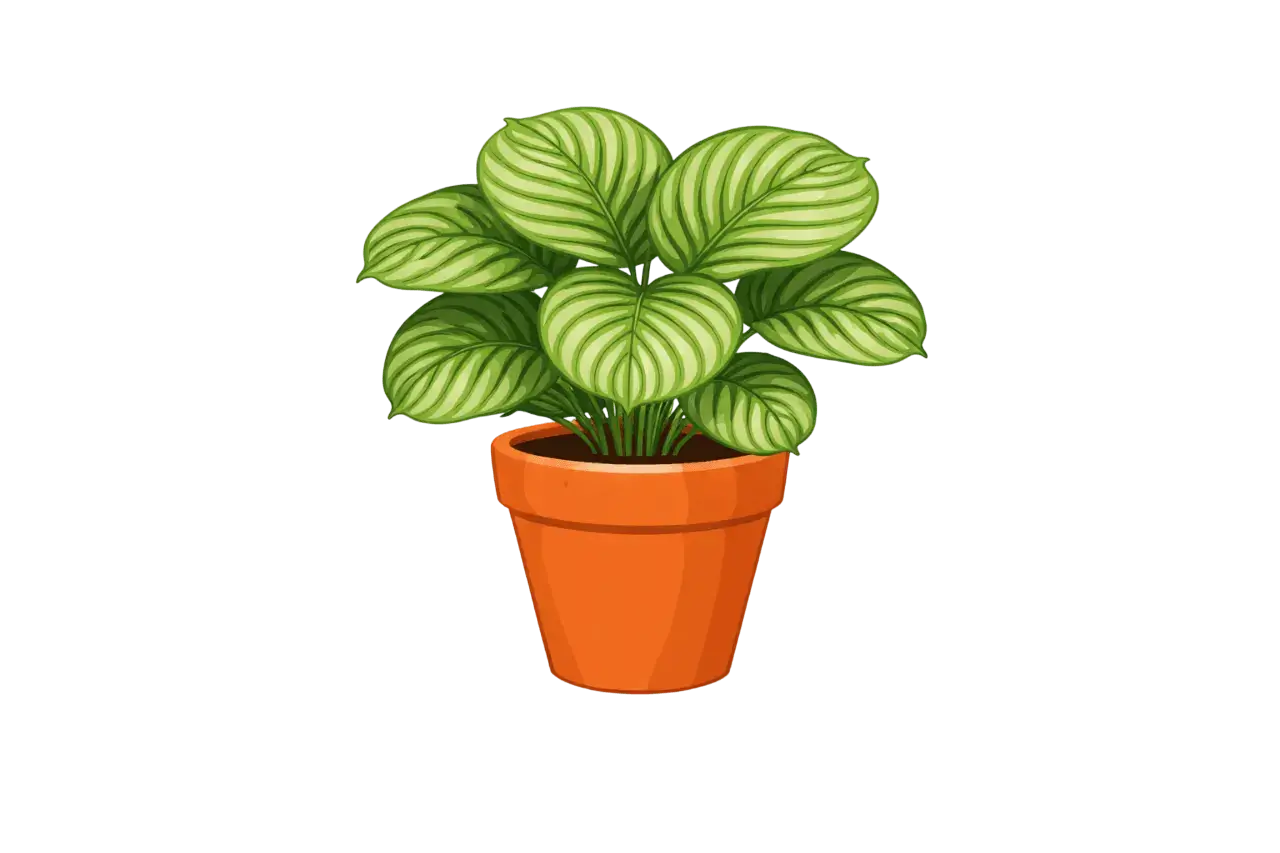
The leaves are the reason anyone puts up with all this. NC State describes them as round, glossy, dark green with silver-green stripes, paler green to silver underneath, and up to 12 inches wide on a plant 2 to 3 feet tall. The RHS allows two to five years to reach full size, where NC State rates the growth rate rapid, so expect somewhere between the two. On the safety question it is unambiguous: the ASPCA lists Calathea spp. as non-toxic to dogs, cats and horses, and NC State agrees for cats and dogs.
Quick Info
- LightMedium
- WaterMedium
- Size2-3 feet tall, 1-2 feet wide
- HumidityHigh
- Temp65-80°F (18-27°C), never below 61°F
- FloweringNo
- TypeTropical
- Dog SafeYes
- Cat SafeYes
- Kid SafeYes
Is Calathea Orbifolia Toxic to Pets?
Pets: The ASPCA lists Calathea spp. as non-toxic to dogs, cats and horses, and NC State rates this species non-toxic for cats and dogs. Unlike the prayer plant, the ASPCA entry here is a genus-level listing under the name the plant is still traded as, so it covers the plant in your pot.
Kids: No toxic principle is recorded for the genus and no source reports irritant sap, so it is a reasonable choice for a house with small children.
Calathea Orbifolia Care Guide
Light, and Protecting the Pattern
NC State files it under partial shade, meaning direct sunlight for only part of the day, two to six hours. The RHS asks for bright indirect or filtered light and lists east, north or west-facing aspects, sheltered. In a room that means a couple of feet back from an east window, or beside a north-facing one, with no direct midday sun landing on the leaves.
Direct sun is the thing to keep off it. The pattern on these leaves is the selling point and strong light washes it out and scorches the thin tissue at the margins. Too little light is less dramatic and still costs you something, since a plant in a dark corner stops producing the large new leaves that make it worth growing. Bright shade is the target, and that phrase is doing real work here.
Humidity and Temperature
This is the make-or-break factor and NC State gives a figure: at least 60 percent, with high humidity needed for the plant to do well. The distance between that and a normal living room is the whole problem. Nebraska Extension measures typical homes at 30 to 50 percent, and Mississippi State has found heated buildings as dry as 10 to 30. A humidifier running near the plant is the only approach that moves ambient humidity reliably.
Standing several plants close together lifts the air around them a little. Misting is close to useless: Nebraska Extension calculated that you would have to do it every few minutes to move a room’s reading at all, and NC State names wet foliage as the route to leaf spot on this species. A bathroom with a window is a legitimately good spot for this plant, and one piece of folk advice that holds up.
The RHS is specific and it is a higher bar than most houseplants: a constant temperature of at least 16°C, which is 61°F, and an H1A hardiness rating meaning glasshouse conditions year round. NC State puts it in USDA zones 11a to 12b. There is no cold tolerance here at all.
Draughts matter as much as the thermometer reading. The RHS says to keep it away from them, and a sheltered position is in its growing requirements. A spot beside a door that opens to the outside in winter, or in the airflow from a vent, subjects the plant to repeated swings even if the room average looks fine.
Watering, Little and Often
Keep the compost moist but never wet or soggy, in NC State’s wording, and water moderately in growth while keeping it just moist in winter, which is how the RHS puts it. The two describe the same narrow band. A moisture meter is more useful on this plant than on most, because the band is narrow at both ends: dry out and the leaf margins crisp, stay wet and the roots rot.
NC State names root rot from overwatering and leaf spot from wet foliage as the two cultural failures. Both point the same way on technique. Water at the soil surface, not over the leaves, let the excess drain fully, and empty the saucer afterward. This is not a plant to leave standing in a reservoir.
Water Quality
Use rainwater or distilled water. NC State says the plant prefers distilled or rain water and names fluoride in tap water as a cause of brown tips, unusually specific for an extension page, and it matches what Penn State documents for the related maranta. Fluoride moves up the transpiration stream and accumulates at the leaf margins, so the damage builds over months of watering from the same tap.
Be careful about the shortcut here. The jug filter on the worktop will not do it either. Carbon cartridges are built for chlorine and taste, and fluoride passes straight through them, so filtered tap water scorches the margins much as unfiltered tap water does. Leaving water to stand overnight off-gasses chlorine and does nothing for fluoride either. If collecting rainwater is impractical, distilled is the reliable option, and it is cheap enough for a plant this size.
Mix and Drainage
NC State asks for loam or silt with good drainage at slightly acidic to neutral pH. The RHS specifies peat-free potting compost, loam-based, moist but well-drained, acid or neutral. Any decent houseplant compost that holds moisture without turning to sludge will do the job.
Drainage is the non-negotiable part, since root rot from overwatering is the named failure. What this plant does not want is the gritty, fast-draining mix that suits a succulent, because then you are fighting to keep it evenly moist. Aim for a compost that stays damp for a few days and then clearly dries at the surface.
Feeding, Monthly and Light
The RHS says to apply a balanced liquid fertiliser monthly. That is the whole published recommendation for this species, so there is no need to complicate it. Feed through the growing season and ease off in winter alongside the watering.
Go light rather than heavy. A plant already struggling with leaf margins does not need fertiliser salts accumulating in the pot as well, and the symptoms of overfeeding, brown leaf tips among them, look a great deal like the humidity and fluoride problems you are trying to solve.
Repotting a Rhizome
Spring, and only when it needs it. The RHS gives two to five years to reach ultimate size, so a plant growing well will fill a pot in a couple of seasons. Step up one size, since a large volume of wet compost around the rhizomes invites the root rot that NC State names as the main cultural problem.
Growth comes from rhizomes spreading sideways, so a wide pot suits the plant better than a deep one, and repotting is the natural moment to divide a clump that has outgrown its space. Skip the feed for the first few weeks while the roots take hold.
Grooming Big Leaves
The RHS gives one instruction: cut away dead leaves as necessary. Remove them where the stalk meets the soil, using clean snips, and resist trimming brown margins into a leaf shape, since the cut edge browns again and you end up with a smaller, odder leaf. If a leaf is mostly gone, remove the whole thing and let the rhizome replace it.
Dust shows badly on leaves this size and this glossy, so wipe them with a damp cloth and dry them off afterwards. The drying matters, given that NC State attributes leaf spot on this plant to wet foliage. The wipe also puts you close enough to spot red spider mite, which the RHS lists along with glasshouse whitefly as the pests to expect.
How to Propagate a Calathea Orbifolia
Division is the only method. Both authorities agree on that. NC State lists division during the spring; the RHS says to divide the rhizomes in summer. There is no cutting route here. Marantaceae plants grow from rhizomes rather than from stems with nodes, so a leaf or a piece of petiole will not root however long you leave it in water. Do it when you are repotting anyway. Turn the plant out, find where the rhizomes and their attached growing points separate naturally, and work them apart with your fingers where you can. Each division needs a length of rhizome, its own roots, and at least one growing point. Pot them individually into the same moisture-retentive compost.
Then give the divisions better conditions than the parent, not worse. A freshly divided rhizome has reduced roots and the same leaf area to support, so it is briefly much more vulnerable to the dry air that this plant already struggles with. Keep them warm, out of direct sun, and inside a clear bag or propagator for the first couple of weeks if your room is dry.
Expect it to be slow to look like anything. Neither NC State nor the RHS publishes an establishment time for this species, so any specific number of weeks you see quoted is somebody’s estimate. What the RHS does give you is two to five years from a young plant to full size, which sets the pace to expect.
Common Calathea Orbifolia Problems
Crisp brown edges and tips are the signature complaint, and NC State gives two causes: low humidity and fluoride in tap water. Fix both at once by running a humidifier and switching to rainwater or distilled, since treating only one leaves the other working away. Brown leaf tips across other plants takes in the wider picture.
Curling leaves usually accompany the same shortfall, since a plant losing water faster than it can take it up reduces its exposed surface. Check humidity first, then whether the compost has been allowed to dry out, and then whether a draught or a radiator is drying the air around that one shelf.
Yellowing leaves with compost that stays wet point at the roots. NC State names root rot from overwatering as the main cultural failure for this species. Ease off, confirm the pot drains, and check the rhizomes for softness. Yellowing on other plants separates out the causes that mean something else.
Spots on the leaves, often with wet-looking margins, trace back to water sitting on the foliage. NC State attributes leaf spot on this plant to wet leaves specifically, so water at the soil and dry the leaves after you wipe them. Avoid misting directly onto the plant for the same reason.
A washed-out, faded pattern means too much light. The silver-green striping is the whole point of the plant and strong light bleaches it, so move it back from the glass or filter the light. Red spider mite and glasshouse whitefly are the two pests the RHS lists, and dry air brings the mites, one more reason the humidity matters.
Sudden collapse or widespread damage after a cold night is a temperature problem, not a care problem. The RHS asks for a constant minimum of 16°C and explicitly rates the plant H1A, meaning glasshouse conditions year round, so a cold windowsill or an unheated room in winter is outside what the plant tolerates.
New leaves emerging smaller than the old ones usually means the plant is not getting what it needs to build a foot-wide leaf: light, water, feed and humidity all have to line up. It is a reasonable early warning that one of the four has slipped, and worth checking before the older leaves start browning.
FAQs
NC State names two causes for this species: low humidity and fluoride in tap water. The humidity requirement is at least 60 percent, which most heated homes fall well short of, and fluoride accumulates in the leaf margins over months of watering from the tap. Fix both together, with a humidifier and a switch to rainwater or distilled water, because solving one while the other continues will not stop the browning.
Better not to. NC State says the plant prefers distilled or rain water and specifically names fluoride in tap water as a cause of brown tips. A jug filter is not enough by itself, because activated carbon leaves fluoride untouched, and standing the water overnight only drives off the chlorine. Rainwater or distilled water are the two that actually work.
Both names refer to the same plant, and Goeppertia orbifolia is the accepted one now. NC State and the RHS both file it under Goeppertia, with Calathea orbifolia, Calathea rotundifolia, Maranta orbifolia and Maranta rotundifolia listed as synonyms. The trade still sells it as a calathea, so that is the name on the label and in most searches. Nothing about the care changes with the name.
Eastern Brazil, according to both Kew and NC State, which specify the Northeast and Southeast regions. Bolivia is the answer you will find on most care pages and it does not match either authority. The habitat it comes from is what sets the care: warm, humid, shaded forest understorey. That is why the RHS rates it a glasshouse plant and not an ordinary houseplant.
NC State gives at least 60 percent, and says high humidity is needed for the plant to do well. For scale: a typical home sits at 30 to 50 percent on Nebraska Extension figures, and a heated building can fall to 10 to 30 on Mississippi State figures. A humidifier near the plant is the only method that reliably moves ambient humidity. Misting mostly wets the leaves, and wet leaves are how NC State says leaf spot starts here.
Yes. The ASPCA lists Calathea spp. as non-toxic to dogs, cats and horses, and NC State rates this species non-toxic for cats and dogs. The ASPCA entry is a genus-level listing filed under the name the plant is still traded as, so it covers what is in your pot without any of the binomial ambiguity that affects the prayer plant listing.
By division, and only by division. NC State lists division during the spring and the RHS says to divide the rhizomes in summer. There is no stem or leaf cutting route, because Marantaceae plants grow from rhizomes, not from stems with nodes, so a leaf in a jar of water will never root. Separate the rhizomes when you repot, keeping a growing point and roots on each piece.
Too much light is the usual cause. Strong light bleaches the silver-green striping and scorches the thin tissue at the leaf margins. NC State files the plant under partial shade for that reason, and the RHS asks for bright indirect or filtered light. Move it back from the window or filter the light. New leaves will come in properly patterned, though faded leaves stay faded.