How to Care for an African Mask Plant
Alocasia × amazonica
The name manages to be wrong twice. No Alocasia species is native to South America, as Missouri Botanical Garden points out, so the amazonica in Alocasia × amazonica is not geography. MOBOT reports that some authorities take the name as one applied by Salvadore Mauro in the 1950s to a hybrid he made at his Miami nursery, which was called Amazon Nursery. The plant is named after a shop in Florida. It is not African either, since the parent species come from southeast Asia.
There is a competing account worth knowing if you check the references. NC State files the same cross as Alocasia × mortfontanensis and credits it to the French horticulturist M.M. Chantrier of Mortefontaine, with Alocasia longiloba and Alocasia sanderi as the parents. Both stories describe the same pairing, made independently on two continents, so your plant can be labelled either way and both labels have a case.
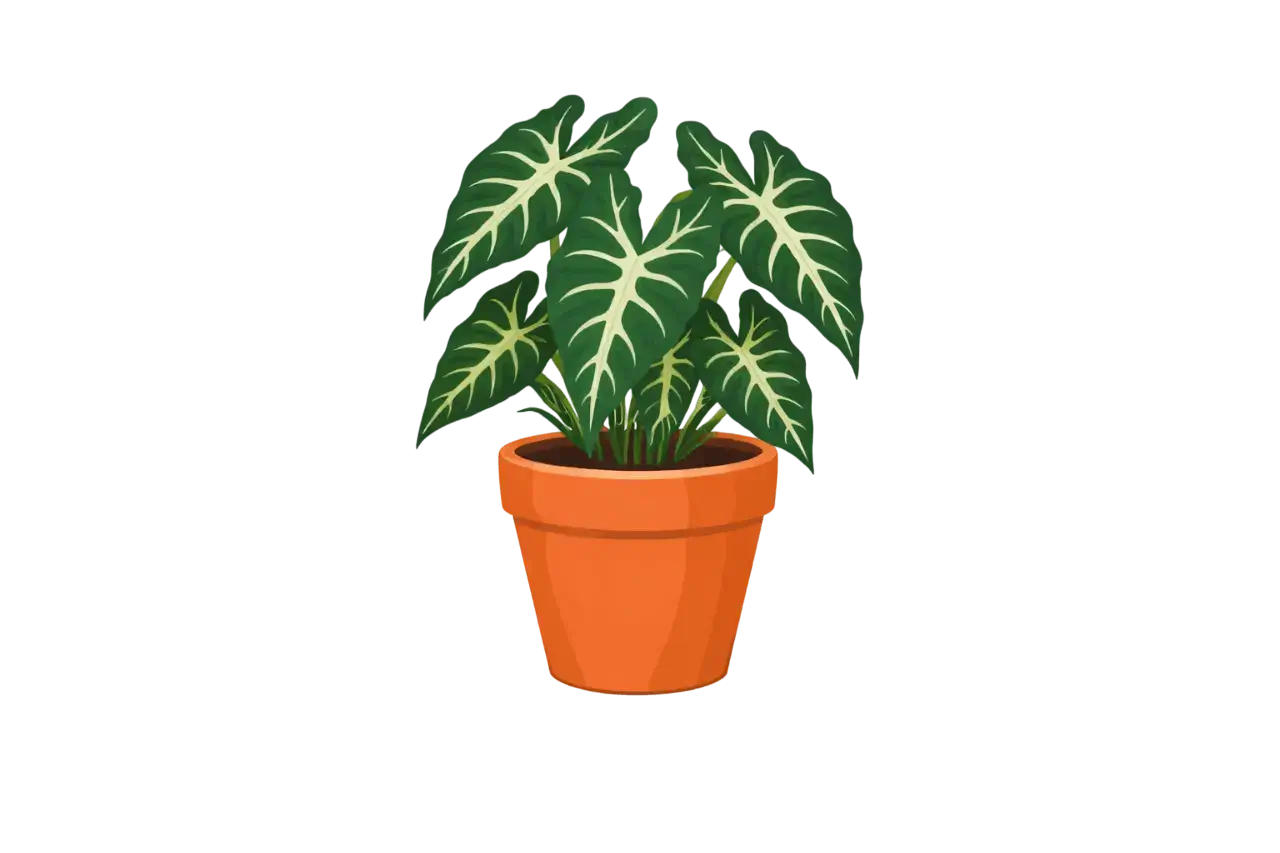
MOBOT lists its native range as, simply, garden origin. What you actually have is a compact hybrid with leathery, wavy-edged, arrowhead leaves reaching 16 inches long, dark bronze-green with thick white to silvery-green main veins and purple undersides. ‘Polly’ is the smaller selection most shops stock, and the whole plant stays around 1 to 2 feet in each direction. It is an aroid, close enough to dieffenbachia in both looks and chemistry that the two share the same warning label.
That warning repays a proper read, because this plant gets handled more than most. The ASPCA lists Alocasia as toxic to dogs, cats and horses on insoluble calcium oxalates. NC State goes further and rates the severity medium, names every part as poisonous including the sap, and lists contact dermatitis and eye injury alongside the ingestion symptoms. Almost no care page mentions the second half of that. Wear gloves when you cut it, and keep the sap away from your eyes.
Quick Info
- LightMedium
- WaterMedium
- Size1-2 feet tall and wide
- HumidityHigh
- TempAbove 60°F (16°C); no frost tolerance
- FloweringYes
- TypeTropical
- Dog SafeNo
- Cat SafeNo
- Kid SafeNo
Is the African Mask Plant Toxic to Pets?
Pets: The ASPCA lists Alocasia spp. as toxic to dogs, cats and horses on insoluble calcium oxalates, with oral irritation, pain and swelling of the mouth, tongue and lips, excessive drooling, vomiting (not in horses) and difficulty swallowing. NC State rates the severity medium, records every part as poisonous including the sap, and lists contact dermatitis and eye injury alongside the ingestion symptoms.
Kids: NC State lists flowers, fruits, leaves, roots, sap, seeds and stems as poisonous, with mouth, lip, tongue and throat pain and difficulty speaking among the symptoms. Keep it out of reach and wear gloves when you cut it.
African Mask Plant Care Guide
Light, and It Is Not a Low-Light Plant
NC State files it under dappled sunlight or partial shade, meaning direct sun for only part of the day, two to six hours, and warns that direct sun scorches the leaves. MOBOT says part shade. In a room that translates to a bright position a little back from an east window, or beside a north-facing one, with nothing landing on the leaves at midday.
This is not a low-light plant, and the point deserves bluntness, since it gets sold alongside plants that are. The leaves are large and thin and the plant is already slow to replace them, so a dim corner buys you a long decline rather than a quick failure. If a bright spot without direct sun is not available, this is the wrong plant for the room.
Watering, and Bacterial Rot
NC State puts the requirement as moist soil, not merely tolerant of it, and MOBOT asks for consistently moist, organically rich, well-drained compost. So the target is evenly damp, never dry through and never waterlogged. A moisture meter helps on a plant with a narrow band at both ends, especially in a chunky mix where the surface dries while the core stays wet.
Get the wet end wrong and the consequence is worse than usual. NC State names both root rot and bacterial stem rot as the results of overwatering, and the second of those is the one that kills: once rot is moving up inside the stem there is nothing to treat. Water at the soil, empty the saucer, and if a pot has already been kept too wet, root rot and soil mould look different and are worth telling apart before you act.
Mix, Drainage and Repotting
NC State asks for loamy, well-drained, fertile soil at acid to neutral pH; MOBOT suggests a soil-based potting mix. The practical version is an ordinary houseplant compost with enough perlite or bark worked through it that water moves rather than sits, while the mix still holds the moisture the plant needs between waterings.
Drainage is doing one specific job here: keeping bacterial stem rot away from the base of the plant. A pot that holds a reservoir at the bottom, or a decorative outer pot that quietly fills up, is the common way this goes wrong on a plant that otherwise wants to stay damp.
Spring, and only when the plant has filled its pot. NC State lists propagation as division of offsets, which tells you what you will find when you turn it out: a cluster of small plants around the parent, not one root mass. That makes repotting and propagating the same operation.
Step up one size. A large volume of wet compost around a plant this prone to stem rot is the wrong trade, and the plant is small enough at 1 to 2 feet that it does not need much room. Hold off feeding for a few weeks while the roots settle.
Humidity, a Real Requirement
NC State records high humidity as preferred and MOBOT calls for humid environments, so this is a real requirement and not a nice-to-have. Indoor air rarely obliges: typical heated homes run 30 to 50 percent on Nebraska Extension measurements, and Mississippi State has recorded some down at 10 to 30. Closing that gap is the job of a humidifier.
Clustering pots does buy you a small amount. A spray bottle is not the answer either. Nebraska Extension worked out that misting would have to be repeated every few minutes to shift a room’s reading, and on a plant this prone to bacterial rot, wet leaves cost more than the brief lift is worth. A bright bathroom is a better answer than a spray bottle.
Temperature, and the 60F Floor
MOBOT gives a floor and it is higher than people expect: these plants require temperatures above 60°F. NC State rates it hardy only in USDA zones 10a to 12b, a band with no winter in it. A cold windowsill in winter, or the draught from a door that opens outside, is enough to set the plant back.
The 65 to 80°F band in circulation for this hybrid is reverse-engineered from that 60°F floor instead of measured. No optimum has been published, so the floor is the only number here worth trusting. Ordinary room temperature is fine. Steadiness matters more than the exact number, and a plant moved between a warm room and a cold hallway will show it.
Feeding, Underdone
A balanced liquid feed through spring and summer, stopping over winter when growth slows. NC State rates the growth rate medium and publishes no feeding schedule, so monthly at label strength is a reasonable reading and not a cited one.
Underdo it instead of overdoing it. The leaves are the whole point of this plant and fertiliser salts build up in a pot that is kept evenly moist and never properly flushed, so water thoroughly enough that some runs out of the bottom and tip the saucer away afterwards.
Winter Behaviour
Alocasias are notorious for losing leaves over winter and then recovering in spring. The evidence deserves a straight answer. I could not find an extension service or botanic garden documenting an indoor winter dormancy for this hybrid. What NC State does say is to reduce watering before overwintering, and MOBOT notes that rhizomatous varieties should stay potted year round while tuberous ones can be lifted and stored.
The practical upshot is the same either way. Growth slows or stops in low winter light, the plant needs much less water than it did in July, and continuing to water on a summer schedule into a dormant plant is how root rot starts. Ease off, keep it above 60°F, and do not feed. If leaves drop but the rhizome stays firm, there is something to come back in spring.
Handling, and Why Gloves
There is little to prune. Cut spent leaves away where the stalk meets the rhizome, using clean snips, and wear gloves while you do it. NC State lists contact dermatitis and eye injury among the hazards and names the sap as poisonous, so this is one plant where the handling advice is not boilerplate.
Give the leaves a wipe with a damp cloth now and then. They are big, glossy and horizontal, so they collect dust faster than most foliage, and wiping is how you find spider mites early. Wash your hands afterwards for the same reason you wore the gloves.
How to Propagate an African Mask Plant
Division of offsets is the method NC State gives, and it is the only practical one at home. The plant produces small plantlets from its rhizome around the base of the parent, so what looks like one plant in a pot is usually a family of them. Spring, as part of repotting, is the moment.
Turn the plant out and wash or shake enough compost away to see what you are doing. Separate the offsets where they come away naturally, keeping roots on each one, and use a clean blade only where they will not part. Pot them individually into the same moisture-retentive mix, water once, and keep them warm and humid while they take hold.
Gloves on for all of it. NC State lists the sap among the poisonous parts and records contact dermatitis and eye injury, and division is the one job that puts you in contact with cut tissue and root sap at the same time. Rooting hormone is unnecessary here, since an offset arrives with roots of its own.
Nobody publishes an establishment time for this hybrid, so expect the divisions to sit still for a while and treat any specific figure you read as a guess. Keep them above 60°F throughout, since a small division with reduced roots has even less margin for cold than the parent did.
Seed is not an option here: the plant is a hybrid, so seedlings would not come true even if it flowered for you, which NC State says it rarely does indoors.
Common African Mask Plant Problems
Yellowing leaves with compost that stays wet means the roots are in trouble, and NC State names root rot and bacterial stem rot as the consequences of overwatering. Check the stem base for softness before anything else. Reversing an overwatered pot is the first move, and yellowing on other plants covers the causes that point elsewhere.
A soft, darkening stem base with the plant collapsing from the middle is bacterial stem rot, and there is no treatment. Salvage what you can: separate any firm offsets, wash the old compost off their roots, and pot them into fresh mix in a clean pot. Discard the parent and its soil instead of reusing either.
Crisp brown edges point at the air rather than the pot, given that both NC State and MOBOT ask for high humidity. Check for a radiator or a vent near the plant before you buy anything, since a draught of dry warm air does more damage than a merely dry room.
Scorched pale patches come from direct sun, which NC State says will scald the leaves. Move the plant out of the beam. Those marks stay on the affected leaves, so judge whether the move worked by looking at the new growth instead.
Leaves dropping over winter is the complaint this plant is famous for. Growth slows in low light, the plant needs far less water, and watering on a summer schedule into a slowed plant is what turns a seasonal pause into root rot. Ease off the water, keep it above 60°F, stop feeding, and check that the rhizome is still firm.
Spider mites, mealybugs and aphids are the three NC State lists, and MOBOT singles out spider mites specifically. Dry air brings the mites, so they tend to arrive on the same plants that are showing brown edges. Identifying houseplant pests goes through the differences.
Very few new leaves, on a plant that otherwise looks sound, usually means light. This one needs two to six hours of dappled sun by NC State’s reckoning, and a position that merely feels bright to you may be well under that. Growth should be medium-paced in good conditions, not glacial.
FAQs
The common name describes the look of the leaf rather than where the plant comes from. The parent species are southeast Asian, and the botanical name is no more accurate: MOBOT notes that no Alocasia species is native to South America, and reports that the amazonica in Alocasia x amazonica is taken by some authorities to refer to the Amazon Nursery in Miami, where Salvadore Mauro made the hybrid in the 1950s. Two misleading names on one plant.
You will see both, and both have a case. MOBOT uses Alocasia x amazonica and ties it to Salvadore Mauro in Miami. NC State files the same cross as Alocasia x mortfontanensis and credits the French horticulturist M.M. Chantrier of Mortefontaine, with Alocasia longiloba and Alocasia sanderi as parents. The same pairing appears to have been made independently in two places. Neither name changes the care.
Yes, and more so than the usual houseplant warning suggests. The ASPCA lists Alocasia as toxic to dogs, cats and horses on insoluble calcium oxalates, causing oral irritation, pain and swelling of the mouth, tongue and lips, drooling, vomiting and difficulty swallowing. NC State rates the severity medium, lists every part as poisonous including the sap, and adds contact dermatitis and eye injury for people handling it. Wear gloves when cutting it.
Nearly always because growth stopped and the watering did not. I could not find an extension service documenting a true indoor dormancy for this hybrid, so treat the dormancy talk with some caution, but the underlying situation is real enough: low winter light slows the plant down, it needs far less water than in summer, and watering on the old schedule is how root rot begins. Ease off, keep it above 60F, stop feeding, and check the rhizome is firm.
Not well. NC State puts it in dappled sunlight or partial shade, meaning two to six hours of direct sun, and warns that full direct sun scorches it. That is a fairly narrow band and it sits well above what a dim corner provides. The leaves are large and thin and the plant replaces them slowly, so poor light produces a slow decline instead of an obvious failure.
Divide the offsets. NC State lists division of offsets as the propagation method, and the plant obliges by producing small plantlets from its rhizome around the base of the parent. Turn it out in spring, separate the offsets with roots attached, and pot them individually in the same mix. Wear gloves, since the sap is among the parts NC State lists as poisonous. Seed is pointless on a hybrid, and it rarely flowers indoors anyway.
MOBOT gives up to 16 inches long for the leaf blade, leathery and wavy-edged with thick white to silvery-green main veins, on a plant that stays around 1 to 2 feet tall and wide. NC State notes the undersides are purple and that both the length and the width of the leaf exceed 6 inches. The cultivar Polly, which is what most shops sell, sits at the compact end of that.
Below 60F. MOBOT states that these plants require temperatures above 60F, and NC State confines it to USDA zones 10a to 12b, which leaves nothing in reserve below that. A cold windowsill behind a curtain on a winter night, or a draught from a door opening outside, is enough to check the plant. Steady warmth matters more than hitting any particular number above that floor.