How to Care for a Prayer Plant
Maranta leuconeura
Most prayer plants come home healthy, develop brown dead leaf tips within a few months, and get a humidifier bought for them. Penn State Extension’s list of causes for tip burn on maranta does not mention dry air.
It names phosphate fertilizer, fluoride toxicity and high light intensity. The giveaway is a thin yellow border between the dead tissue and the living leaf. So if you are running a humidifier while watering from a fluoridated tap and feeding a high-phosphate bloom formula, the browning carries on regardless.
Maranta leuconeura grows on the forest floor in central and eastern Brazil, and it keeps that habit indoors. It spreads sideways from shallow rhizomes and never climbs. The RHS puts its ultimate height at 12 to 15 inches and allows five to ten years to get there, so a plant that still looks small after one season is on schedule. What it gains instead is width, and a mature clump fills a wide bowl long before it gains any height.
Illinois Extension gives one warning that should change how you water: do not allow water to stand on the crowns, because the stems rot easily. Pour at the soil surface around the rim, not down into the middle of the clump, and empty the saucer 15 minutes afterwards as the New York Botanical Garden advises. Penn State reaches the same place from a different direction. Its management line for this plant’s leaf spot disease is to avoid overhead watering.
The ASPCA lists prayer plant as non-toxic to cats, dogs and horses. Open the entry, though, and the scientific name on it is Calathea insignis, a different Marantaceae plant sold under the same common name. Nobody records a toxic principle for Maranta leuconeura itself, and no source reports irritant sap, so it is treated as safe around pets and children. The listing just does not name the species in your pot.
Quick Info
- LightMedium
- WaterMedium
- Size12-15 inches tall and wide
- HumidityHigh
- Temp65-70°F (18-21°C), never below 55°F
- FloweringYes
- TypeTropical
- Dog SafeYes
- Cat SafeYes
- Kid SafeYes
Is Prayer Plant Toxic to Pets?
Pets: The ASPCA lists prayer plant as non-toxic to cats, dogs and horses, but the binomial on that entry is Calathea insignis, a different Marantaceae plant sold under the same common name. No toxic principle is on record for Maranta leuconeura itself, and no source reports irritant sap.
Kids: Nothing in the plant is recorded as poisonous, and handling it carries no sap or irritant warning in any authoritative source.
Prayer Plant Varieties
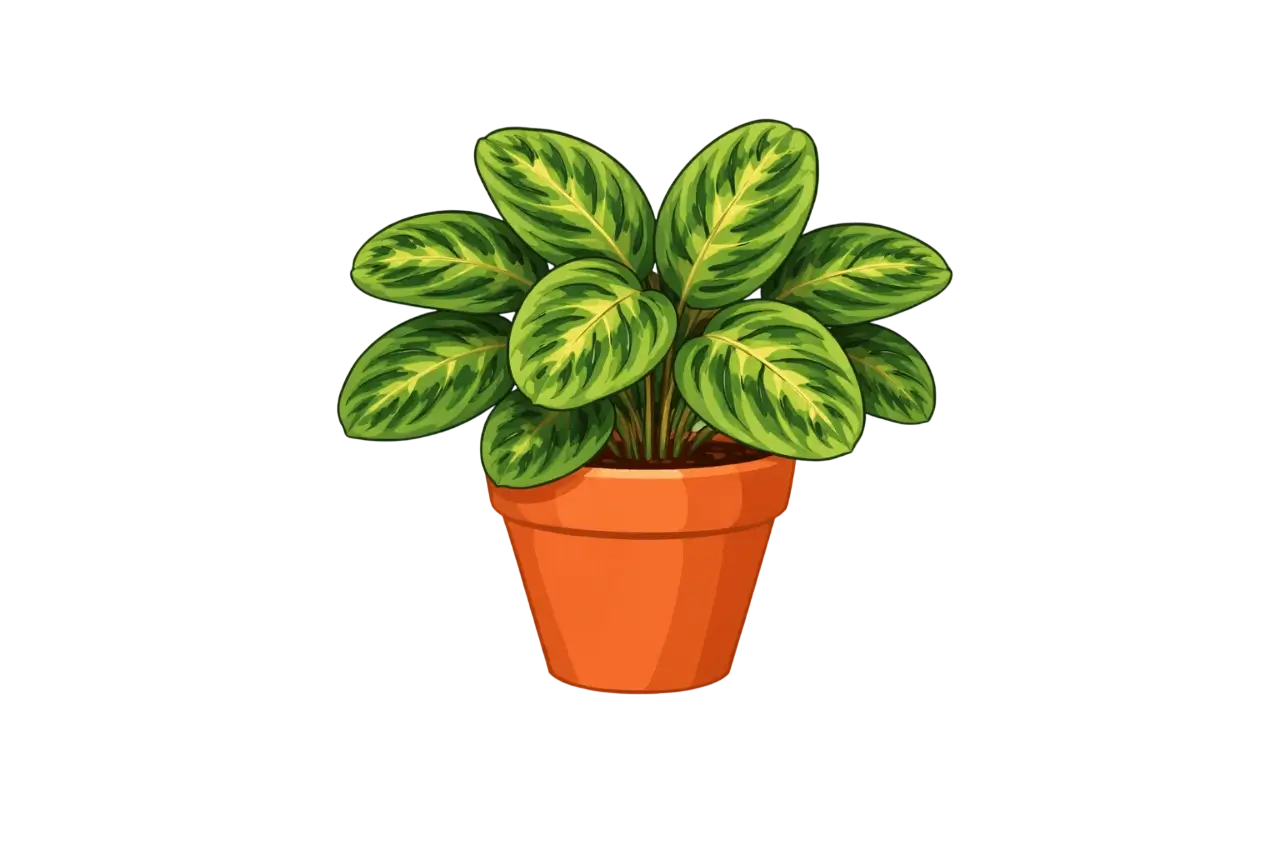
‘Kerchoviana’, sold as rabbit’s foot or rabbit tracks. Pale green leaves carrying dark blotches in pairs along either side of the midrib. The RHS records ‘Ten Commandments’ as another common name for it, after the blotch count. UF/IFAS reports that this and ‘Erythroneura’ together account for more than 95 percent of nursery maranta production, so one of the two is almost always what you are buying.
var. erythroneura, the red prayer plant or herringbone maranta. Boldly patterned olive-green leaves with a showy red midrib, parallel red veins running out from it, and reddish-purple undersides. Missouri Botanical Garden puts it at 1 to 1.5 feet tall and wide, flowering May to July.
A note on the labels: POWO and Catalogue of Life both sink var. erythroneura and var. kerchoveana into Maranta leuconeura, so neither is an accepted botanical variety any more, even though the trade still prints them that way. The plants are real and easy enough to tell apart. It is the rank on the label that no longer stands up.
Prayer Plant Care Guide
Light, and Keeping the Pattern
Prayer plant sits in the medium band. The University of Arkansas puts the minimum at 75 to 100 foot-candles and the preferred range at 200 to 500. In a house that means a few feet back from an east window, beside a north-facing one, or well into the room from a south window with a sheer curtain in the way. Direct sun bleaches the pattern out. Missouri Botanical Garden’s phrasing for it: too much sun washes away the colours you bought the plant for.
Too little light costs you the pattern as well, just more slowly. NC State notes the colours fade in poorly lit conditions, and below that 75 foot-candle floor the plant keeps the leaves it has and stops making new ones. Brighter is not the answer either. Penn State lists high light intensity as one of three causes of tip burn, so the window is narrow at both ends and moving the plant to the sunniest spot you own will not fix it.
Watering, and What to Water It With
Keep the soil evenly moist from March through September, then ease off in winter so the top inch dries between waterings. The New York Botanical Garden specifies tepid water, and that matters more than it sounds on a plant that wants to stay above 55°F. Empty the run-off dish 15 minutes after you water and do not leave the pot standing in it.
No extension service publishes a watering interval in days for maranta. Judge it from the soil. A moisture meter earns its place because the band is narrow: evenly moist, never waterlogged, with root rot waiting in soil that does not drain. Aim the water at the surface near the rim, never into the centre of the clump, for the crown rot reason above.
Fluoride is the water problem worth taking seriously, and the only one with a citation attached. Penn State names fluoride toxicity as a cause of tip burn on maranta, and tap water in most municipal systems carries fluoride at around one part per million. It accumulates in the foliage instead of passing through. Fluoride travels up the transpiration stream and collects at the leaf margins, exactly where the damage shows. A plant watered from the same tap for two years has been building toward it the whole time.
Rainwater or distilled water fixes it. A jug filter will not get you there. Activated carbon takes out chlorine and improves the taste while leaving fluoride exactly where it was, which is why filtered tap water does not stop tip burn. Standing water overnight has the same limitation: the chlorine gasses off and the fluoride stays. The New York Botanical Garden separately advises against hard water because it leaves mineral deposits on the leaves. Chloramine sensitivity in maranta is hobbyist talk, unsupported anywhere, so fluoride and hardness are the two to manage.
Mix, and Why Not Perlite
A soil-based mix with added peat and sharp sand suits it, kept loose in the pot and not pressed down. NC State uses peat moss or humus with coarse sand and loam. Drainage is the requirement behind every version, since root rot is what happens in soil that stays wet. Penn State asks for a pH near 6 so iron stays available to the roots.
Penn State Extension also says to avoid perlite. Perlite and superphosphate both carry excessive fluoride, and fluoride is a named cause of the tip burn this plant is prone to. Use coarse sand, pumice or fine bark for aeration instead. Nearly every potting recipe online reaches for perlite by reflex, and for most houseplants that is fine. Maranta is one of the few plants where an extension service tells you not to.
Temperature and Humidity
Household temperatures of 65 to 70°F are ideal. The number to remember is the floor: keep it above 55°F, away from cold drafts and sudden swings. No extension source gives a cold damage threshold with named symptoms for maranta, so the claims you see about leaves blackening below a particular temperature are invented. A spot beside a door that opens all winter is worse for this plant than a slightly dim shelf.
Humidity should sit well above 50 percent. That is awkward, because the average house is nowhere near it. Nebraska Extension measures typical homes at 30 to 50 percent, and Mississippi State has recorded heated buildings down at 10 to 30. Grouping plants together or running a humidifier moves ambient humidity. Misting is where the sources disagree openly: the RHS and Missouri Botanical Garden recommend it, while Nebraska Extension says you would have to mist every few minutes to change a room’s humidity and warns that constant leaf wetness raises disease risk. Penn State’s advice for this plant’s leaf spot is to avoid overhead watering, so I run a humidifier and keep the leaves dry.
Feeding, and Which Product
Feed from March through September and stop over winter. The New York Botanical Garden goes every two weeks with a standard liquid fertilizer, Missouri Botanical Garden says monthly, and the University of Arkansas rates maranta as medium fertility: monthly in spring and summer, every other month in winter, at a teaspoon of soluble houseplant food per gallon. Anywhere in that range is fine.
Which product you use matters more than how often. Penn State names phosphate fertilizer as a cause of tip burn, so a balanced liquid feed is the right call and a high-phosphate bloom formula is not. Skip superphosphate entirely. Underfeeding looks different. Penn State attributes yellowed young leaves to lack of fertilizer or iron deficiency, managed by holding pH near 6 and using micronutrients or an iron chelate.
If you lose track of the schedule, our fertilizer calculator takes the plant type, the season and when you last fed, and tells you whether this one is due yet.
Repotting a Spreading Rhizome
Repot in spring, every one or two years, into that soil-based mix with peat and sharp sand. Step up only one or two inches in top diameter. Mississippi State’s rule of thumb is a pot diameter around a third of the plant’s height measured from the top of the foliage. Oversize it and you get a large volume of wet soil the roots cannot reach into. That is the setup for root rot on a plant that already leans that way.
Growth runs sideways from the rhizomes, so a wide pot fills in faster than a deep one. No source states that as a preference, so take it as my own habit. The one to two inch step-up is the part with a citation. If you are planting several into one broad bowl, UF/IFAS spaces maranta at 8 to 12 inch centres for quick cover. Leave it unfed for a few weeks while the roots settle.
Grooming, and What Not to Trim
The RHS lists no pruning requirement. Cut spent leaves right down to the base using clean snips and leave the rest alone. Nobody has published anything on whether a cut leaf grows back, and the anatomy says it does not. Replacement growth comes up from the crown and the rhizome, not out of the leaf you trimmed.
Wiping the leaves is really an inspection. Rub one between your fingers: a gritty feel means accumulated webbing, cast skins and frass from spider mites, and that is a problem you want caught early. Mites prefer the same warm, dry air that drives tip burn, so the two tend to arrive together.
How to Propagate a Prayer Plant
Rhizome division is the method the botanical and extension sources back. NC State lists rhizomatous division and recommends root cuttings, UF/IFAS gives division of the clumps, and the RHS adds basal cuttings and seed. The anatomy makes it easy. The plant spreads laterally from shallow rhizomes, so a mature clump is already several plants sharing a pot.
Turn it out in spring, when you would be repotting anyway, and pull the root mass apart with your fingers where you can, saving the knife for pieces that will not separate. Each one needs a length of rhizome, its own roots and at least one growing point.
Pot the divisions into the same soil-based mix and keep them evenly moist and warm. Expect them to sit still for a while. Nobody publishes an establishment time for maranta, so the three-to-four-weeks figure you will see quoted is somebody’s guess.
Top cuttings are documented, if indirectly. Penn State’s protocol for a plant carrying root knot nematode is to take top cuttings, throw away the roots and soil entirely, and plant into a pasteurised substrate. Severed top growth re-roots, in other words. Rooting hormone and a humid cover both help. Water rooting is the gap. It may well work, and growers do it constantly, but no extension service or botanic garden records it, so I would call that grower practice and not a sure thing.
One rule covers every method: take material only from a plant with no symptoms. Cucumber mosaic virus travels in propagation material, and Penn State’s management line is to propagate from plants free of the symptoms. A cutting off a plant with yellow line patterns in its leaves gives you a second infected plant, not a spare.
Common Prayer Plant Problems
Brown dead leaf tips and margins, often with a yellow border between the dead and living tissue. This is tip burn, and Penn State names phosphate fertilizer, fluoride toxicity or high light as the causes, not dry air. Our guide to brown leaf tips goes into how the same symptom plays out on other plants.
Small, distorted leaves marked with bright yellow line patterns. That is cucumber mosaic virus, and there is no cure. Destroy the plant, propagate only from symptom-free stock, and keep aphids under control, since they move the virus between plants.
Small water-soaked spots that yellow, die and merge into large irregular tan areas with a yellow halo. This is Drechslera leaf spot. Penn State’s first management step is to stop watering overhead so the foliage stays dry.
Stems collapsing and rotting where they meet the soil. Water has been standing on the crown. Illinois Extension says the stems rot easily, so water around the rim of the pot and keep it out of the centre of the clump.
Yellowing confined to the newest leaves points at lack of fertilizer or iron deficiency. Hold soil pH near 6 and use an iron chelate. Yellowing that starts on the oldest leaves instead is a different problem entirely.
Fine pale stippling on the upper leaf surfaces with webbing between the leaves means spider mites, which favour temperatures in the 80s with humidity under 50 percent. Dealing with houseplant pests has the treatment options.
Tuberous roots that look beaded and galled, on a plant that has stalled. That is root knot nematode. Penn State’s remedy is to take top cuttings, discard the roots and soil, and start again in a pasteurised mix.
FAQs
The movement is nyctinasty, and it runs on a circadian rhythm, not on the room going dark. Folding happens at the pulvinus, a motor joint at the base of each leaf, where cells on opposite sides swell and shrink as potassium and water shift between them. The detailed electrophysiology was worked out in related nyctinastic plants rather than in maranta itself, but the joint and the movement are both well documented here.
Not on its own. The idea that a prayer plant stops praying when something is wrong gets repeated everywhere, but no authoritative source records it as a diagnostic sign, and the movement runs on an internal clock, not on the plant’s condition. Check the leaves themselves for tip burn, spotting or stippling instead, since those are the signs that actually mean something.
Penn State Extension names three causes: phosphate fertilizer, fluoride toxicity and high light intensity. The tell is a yellow border between the dead tissue and the living leaf. Dry air is the popular answer online and it is not on that list, so check your fertilizer label and your water source before buying a humidifier.
It survives there but stops growing. The University of Arkansas puts its minimum at 75 to 100 foot-candles and the preferred level at 200 to 500, so a dark corner falls below what the plant needs to push out new leaves, and the leaf pattern washes out as well. Bright indirect light with no direct sun is the target.
The sources split on this one, so take both halves. The RHS and Missouri Botanical Garden recommend misting and gravel trays. Nebraska Extension says you would have to mist every few minutes to change a room’s humidity, and warns that frequent leaf wetness raises disease risk. Since Penn State’s advice for this plant’s leaf spot is to avoid overhead watering, a humidifier or a cluster of plants is the lower-risk route to the same humidity.
It is treated as safe, with one caveat about the paperwork. The ASPCA prayer plant listing reads non-toxic to dogs, cats and horses, but the scientific name on that entry is Calathea insignis, a different Marantaceae plant sold under the same common name. No toxic principle is on record for Maranta leuconeura and no source reports irritant sap, so there is nothing pointing at a hazard, just no entry filed under the exact binomial.
That pattern points at iron. Penn State attributes yellowed young leaves on maranta to lack of fertilizer or iron deficiency, and the fix is to hold soil pH near 6 and apply micronutrients or an iron chelate. Iron does not move around inside the plant once it is in place, so a shortage shows on the newest leaves first while the older ones stay green.
The RHS gives an ultimate height of 12 to 15 inches and allows five to ten years to reach it, and Missouri Botanical Garden puts the red-veined form at 1 to 1.5 feet tall and wide. It gains width faster than height because growth runs sideways from the rhizomes, so plan for a pot wide enough for a spreading clump and not for headroom.