Why Are My Peace Lily Leaves Turning Yellow?
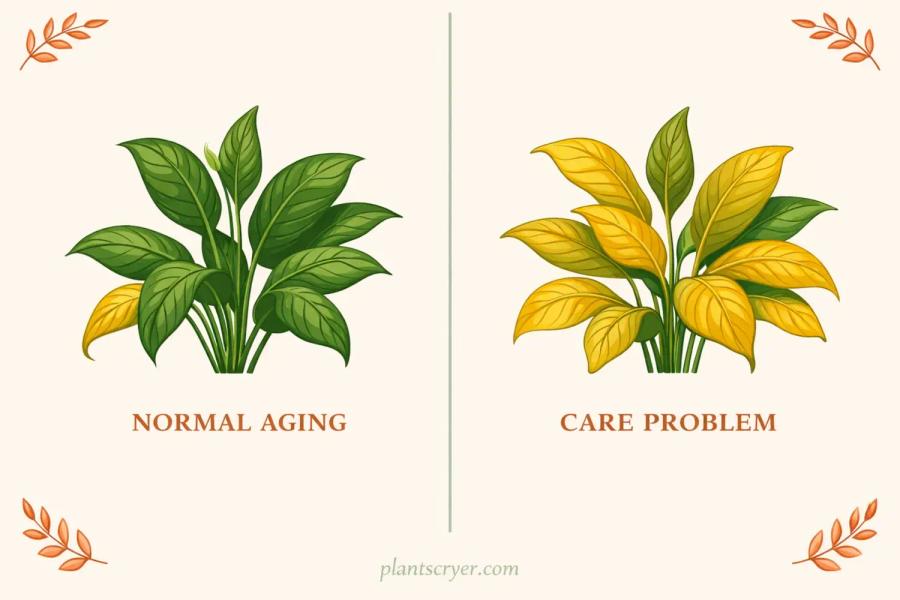
Yellow leaves on a Peace Lily can mean several different things, and the fix depends entirely on which one. Before working through the cause list, look at where the yellowing is happening — the pattern eliminates most guesswork immediately.
A few lower, older leaves yellowing one at a time — almost always normal leaf turnover. Peace Lily regularly drops its oldest leaves as it produces new ones. If the rest of the plant looks healthy and new growth is appearing, remove the yellow leaves and carry on. Nothing is wrong.
Multiple leaves yellowing at once, spread across the plant — a care problem. Keep reading.
Yellowing alongside drooping — go to the Peace Lily drooping guide first. The watering diagnosis there covers the most likely cause and will get you to a fix faster.
1. Overwatering
The most common cause of widespread yellowing. When soil stays constantly wet, oxygen is pushed out of the root zone and roots begin to suffocate. The plant can't take up nutrients properly and leaves yellow — usually starting at the base and spreading upward.
- Yellowing starting from the base of the plant
- Soil feels wet or soggy several days after the last watering
- Pot feels heavy when lifted
- Musty smell from the soil
- Leaves may also be drooping alongside the yellowing
Stop watering. Let the top inch of soil dry out before the next watering. Make sure the pot has drainage holes and the saucer is empty — never let the pot sit in standing water. If the soil smells bad or stems feel soft at the base, check the roots. Overwatering that goes on long enough causes root rot, which needs more urgent action. See our Peace Lily dying guide for root rot rescue steps.
A moisture meter can help if you're consistently misjudging when to water.
2. Underwatering
A Peace Lily that is chronically underwatered — not just occasionally dry, but regularly left too dry for too long — will yellow, often with crispy brown edges developing alongside the yellowing.
- Yellowing with crispy brown tips or edges
- Soil is dry when you check
- Pot feels light when lifted
- Plant may also be drooping
Water thoroughly until it drains from the bottom. Going forward, check the soil every few days and water when the top inch feels dry. Peace Lily should never fully dry out between waterings.
3. Tap Water Quality
Peace Lily is sensitive to fluoride and chlorine in municipal tap water. Fluoride accumulates in leaf tissue over time and causes damage — most commonly brown tips, but in high concentrations it can contribute to yellowing as well. Chlorine in tap water can disrupt soil microbes and root health over months of consistent use. One important note: many municipal water systems now use chloramine rather than plain chlorine. Chloramine does not off-gas the way chlorine does, so leaving water out overnight won't remove it — only a proper filter or reverse osmosis system will.
- Yellowing or browning alongside brown leaf tips
- Plant seems otherwise well-watered and placed correctly
- You've been using unfiltered tap water for a long time
Switch to filtered, distilled, or rainwater. A water filter pitcher that removes fluoride and chlorine is the most practical ongoing solution. Standard carbon filters like Brita reduce chlorine but don't fully remove fluoride — check the filter specs. If switching water isn't practical, flush the soil periodically by running a full pot's worth of filtered or distilled water through it to clear accumulated mineral deposits.
4. Too Much Direct Sun
Direct sun bleaches chlorophyll from the leaves, producing pale yellow patches — usually on the parts of the leaf catching the most light. This is visually distinct from the deeper, more uniform yellowing caused by watering issues.
- Yellowing is pale or washed out rather than deep yellow
- Affected areas are on the side of the plant facing the window
- May have scorched or bleached patches alongside the yellowing
- Problem appeared or got worse after moving the plant
Move to bright indirect light — an east-facing window or pulled back from a south-facing one. Existing yellow patches won't recover, but new growth will come in healthy green once the plant is out of direct sun.
5. Too Little Light
Peace Lily is widely marketed as a low-light plant and it does survive in dim conditions — but surviving is not the same as thriving. In very low light the plant can't photosynthesize efficiently, so older leaves yellow and drop as the plant conserves energy.
- No new growth alongside yellowing
- Leaves that yellow are the older, lower ones
- Plant hasn't flowered in a long time
- Located well away from any window
Move to a brighter spot with indirect light. If natural light is genuinely limited, a full-spectrum grow light running 10 to 12 hours daily makes a real difference. Don't expect overnight results — give it 4 to 6 weeks.
6. Nutrient Deficiency
A Peace Lily that hasn't been fertilized in over a year, or is growing in very old depleted soil, can develop yellowing from nutrient deficiency. The pattern is specific: the leaf tissue between the veins turns yellow while the veins themselves stay green. This is called chlorosis and is typically caused by iron, magnesium, or nitrogen deficiency.
- Yellowing between leaf veins while veins remain green (chlorosis)
- Plant hasn't been fertilized in a long time
- Soil is old, compacted, or hasn't been refreshed in years
Feed with a balanced liquid fertilizer at half the recommended strength. If the soil is very old, repotting in fresh potting mix addresses deficiency more thoroughly than feeding alone. Don't overcorrect with heavy feeding — excess fertilizer creates its own problems.
7. Over-Fertilizing
Too much fertilizer, or feeding at full label strength, causes salt buildup in the soil that interferes with nutrient uptake. The plant can't absorb what it needs and leaves yellow alongside developing brown tips. More common than people expect because fertilizer labels typically recommend more frequent and stronger applications than most houseplants actually need.
- Yellowing alongside brown tips and edges
- White crusty deposits on the soil surface or pot edges
- Plant has been fed frequently or at full label strength
Flush the soil thoroughly by running water through the pot for several minutes to push excess salts out. Hold off fertilizing for 2 to 3 months, then resume at half strength, spring and summer only.
8. Pests
Sap-sucking pests drain Peace Lily of moisture and nutrients, causing yellowing, stippling, or mottled foliage. Spider mites, mealybugs, and scale are the most common culprits. A minor infestation won't cause widespread yellowing, but a heavy or untreated one will.
- Yellowing with fine webbing on leaf undersides (spider mites)
- Yellowing with white cottony masses at leaf joints (mealybugs)
- Sticky residue on leaves or the surface below the pot (scale)
- Yellowing that doesn't respond to watering or light adjustments
Isolate the plant immediately. Treat with neem oil or insecticidal soap, covering all leaf surfaces including undersides. Repeat every 5 to 7 days for 3 to 4 weeks. For mealybugs, manually remove visible clusters with a cotton swab dipped in rubbing alcohol before treating.
9. Temperature Stress or Cold Drafts
Peace Lily reacts to cold air from drafts, AC vents, or cold windows in winter by yellowing — sometimes rapidly. Sudden yellowing that appeared after a temperature event or a move is usually this.
- Yellowing appeared suddenly after a move or cold event
- Plant is near an AC vent, exterior door, or cold window
- Some leaves may have dark edges alongside the yellowing
Move away from cold sources. Keep the plant between 65 and 80°F (18 to 27°C) in a stable spot. Existing yellow leaves won't recover but new growth will come in clean once conditions stabilize.
Do yellow leaves recover?
No. Once a Peace Lily leaf has turned yellow it will not turn green again. Remove yellow leaves by cutting at the base of the stem with clean scissors — this lets the plant redirect energy to healthy growth. Trimming won't cause harm and keeping dead leaves on the plant does nothing useful.
Quick diagnosis
Work through these before reaching for any fix:
- Are only the oldest, lowest leaves yellowing one at a time? Normal aging — remove them and ignore.
- Check the soil. Wet and heavy means overwatering. Bone dry and light means underwatering.
- Is the yellowing pale and washed out? Check for direct sun.
- Are leaf veins still green while the surrounding tissue yellows? Nutrient deficiency or chlorosis.
- Did it appear suddenly after a move or cold snap? Temperature stress.
- Is it slow-developing alongside brown tips? Tap water buildup or over-fertilizing.
- Are there any signs of insects — webbing, cottony clusters, or sticky residue? Check for pests.
Frequently Asked Questions
Yes. Yellow leaves won't recover and the plant gains nothing from keeping them. Cut at the base of the stem with clean scissors.
Yes, it's the most common cause of widespread yellowing. Roots that can't breathe can't take up nutrients, and leaves yellow as a result. If the yellowing is accompanied by drooping and a musty soil smell, overwatering or root rot is almost certainly the cause.
Yellow plus drooping together points strongly to overwatering or root rot. Check the soil moisture and lift the pot — if it's heavy and the soil smells bad, see our Peace Lily dying guide for what to do next.
Lower, older leaves yellowing one at a time is normal leaf turnover. If yellowing is happening across all levels of the plant simultaneously, check for overwatering or nutrient deficiency.
It can contribute over time, particularly in areas with heavily treated water. Fluoride and mineral buildup in the soil interfere with nutrient uptake and are more commonly associated with brown tips than pure yellowing. If tap water is a factor, switching to filtered or distilled water and flushing the soil periodically should show improvement over several weeks.
They don't — yellow leaves stay yellow. The goal is to fix the underlying cause so new growth comes in healthy green. Remove yellow leaves to keep the plant tidy and redirect energy to new growth.
For full Peace Lily care instructions, see our Peace Lily Care Guide.