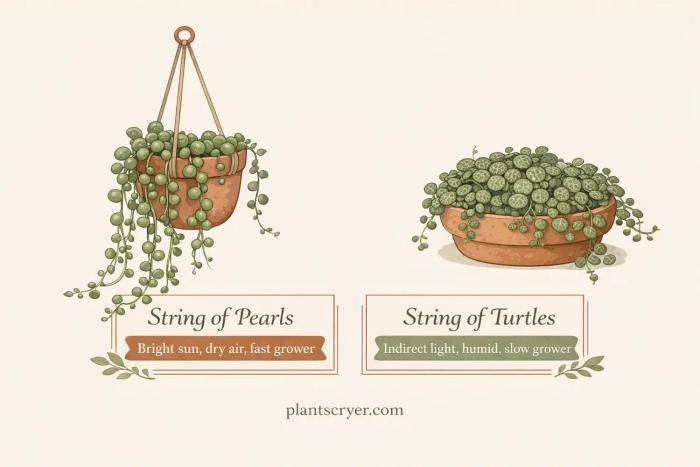

String of pearls and string of turtles share a naming convention and not much else. One is a South African succulent that wants sun and dry air. The other is a Brazilian rainforest plant that wants humidity and shade. Buying the wrong one for your conditions is the most common reason people struggle with either plant.
Here's how to choose.
At a Glance
How to Tell Them Apart
String of pearls has perfectly spherical, pea-sized beads on long slender stems. Stems trail freely and the beads are solid glossy green, each with a thin translucent band that lets light reach the interior of the leaf. It's a desert adaptation that allows the plant to photosynthesize while minimising water loss.
String of turtles is compact and dense by comparison. The leaves are small, flat, and round with intricate white or silver veining on a dark green base that resembles a turtle shell up close. Stems grow outward rather than cascading dramatically downward.
They're not related despite the similar names. String of pearls belongs to the Curio genus in the daisy family (Asteraceae). String of turtles is a Peperomia, part of the pepper family (Piperaceae). Different families entirely.
The Key Care Differences
Both plants will rot if overwatered and both need good drainage. That's where the similarities end.
Light: Pearls needs some direct sun, ideally a couple of hours of gentle morning or late afternoon light. Without it, stems go bald at the base as the plant sacrifices older growth, a slow decline most people don't notice until it's advanced. Turtles is the opposite. Direct sun scorches its leaves and fades the shell pattern. Bright indirect light only.
Humidity: Pearls actively dislikes humidity. Don't mist it, don't put it in a bathroom, dry air is fine. Turtles wants 40 to 70 percent humidity and will struggle through a dry winter heating season without some help. A small humidifier nearby or a naturally humid room like a kitchen or bathroom makes a real difference.
Watering: Pearls goes nearly dry between waterings, every two to three weeks in the growing season. Turtles needs watering more frequently, every ten to fourteen days, but should never sit soggy. Both do well in terracotta pots which wick excess moisture away from the roots passively. A moisture meter takes the guesswork out while you're calibrating to either plant.
Growth rate: This one surprises people. Pearls is a fast grower that trails dramatically within a season. Turtles is one of the slowest houseplants available, taking three to five years to reach mature size. If you buy a small cutting, set patient expectations.
For full seasonal care on either plant, see the String of Pearls care guide and String of Turtles care guide.
Which One Is Easier?
String of turtles is more forgiving. It shows stress slowly and tolerates some neglect once established.
String of pearls has a reputation for looking fine one week and collapsing the next. The usual culprits are overwatering and insufficient light, both of which cause damage that isn't obvious until it's advanced. The margin for error is tighter than most guides suggest.
If you tend to overwater or are newer to houseplants, turtles is the safer pick.
Which One Should You Get?
Get string of pearls if:
- You have a bright window with some direct morning or afternoon sun
- Your home runs dry, especially in winter
- You tend to underwater rather than overwater
- You don't have pets. Ingestion causes vomiting and lethargy, and the sap can irritate skin on contact
- You want dramatic trailing growth without waiting years
String of pearls can be hard to find locally in a healthy established size. Look for mature plants rather than small cuttings for the best start.
Get string of turtles if:
- You have bright indirect light but no direct sun
- You have pets. It's non-toxic to cats and dogs
- You want something compact for a small space, terrarium, or desk
- You have a naturally humid room or are willing to run a humidifier
- You're patient. This plant moves slowly
String of turtles can be harder to find in local nurseries than pearls. Look for established plants rather than small cuttings for the best start.
A Note on Toxicity
String of pearls is toxic to cats, dogs, and humans. Ingestion causes vomiting and lethargy in pets, and the sap can cause skin irritation on contact in humans. If you have pets that investigate plants or young children in the house, this is the most important factor in your decision.
String of turtles is non-toxic to pets and humans. For households with cats or dogs, it's the clear choice between the two.