
String of Turtles (Peperomia prostrata) is one of the more rewarding trailing plants to propagate — once you understand its quirks. The vines root readily from stem cuttings, but this plant has unusually delicate, thread-like roots that snap easily, and it strongly prefers higher humidity during the rooting process. Nail those two things and you'll have new plants in a matter of weeks.
This guide covers the three most reliable methods for String of Turtles propagation, when to use each one, and the mistakes that cause cuttings to fail before they ever root. Already growing one? Check out our String of Turtles care guide for full care details.
When to Propagate
Spring and early summer are ideal — the plant is actively growing, cuttings root faster, and the mother plant recovers more quickly. That said, String of Turtles propagates reasonably well year-round if you can keep the environment warm (65–80°F) and humid.
Propagation is also a natural companion to pruning. Any leggy or elongated vines you'd trim off anyway make perfect cuttings.
What You'll Need
- Clean scissors or pruning snips — sharp, sterile cuts reduce rot risk
- Small pot with drainage holes
- Well-draining potting mix (cactus/succulent mix or standard potting mix amended with perlite)
- Optional: sphagnum moss for the layering/moss method
- Optional: rooting hormone gel — not required, but speeds things up
- Humidity dome, clear plastic bag, or cloche
- Small jar for water propagation
Sterilize your scissors with isopropyl alcohol before cutting to prevent introducing bacteria or fungal issues to fresh wounds.
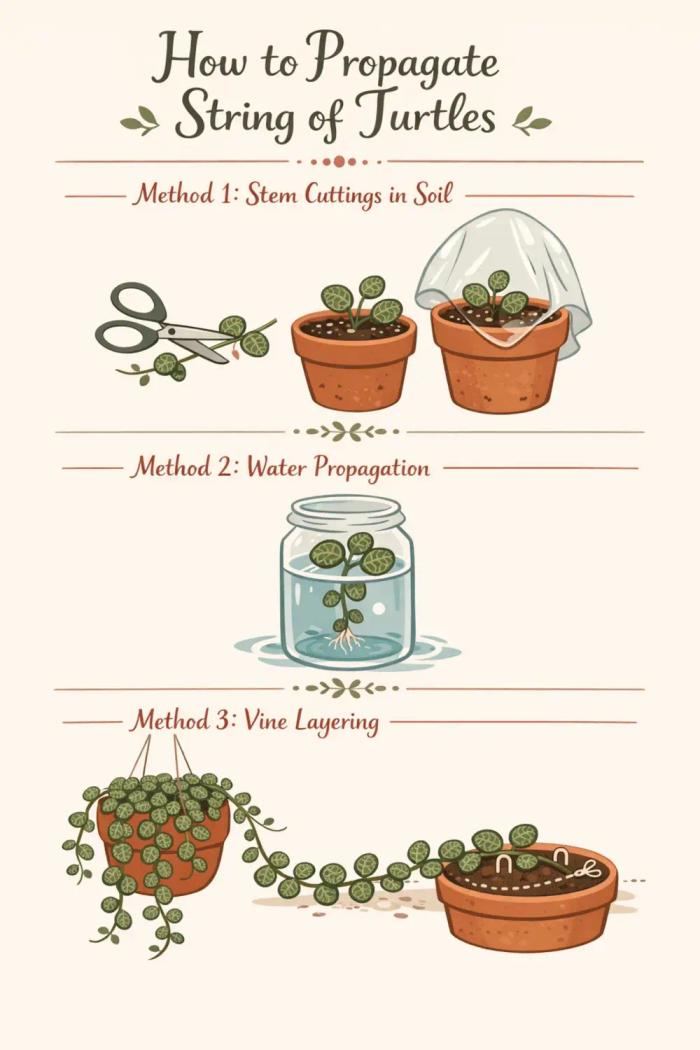
Method 1: Stem Cuttings in Soil
This is the highest-success method for String of Turtles and produces rooted plants faster than water propagation.
- Select a healthy vine and cut a 4–6 inch section just below a node, at a 45-degree angle. Nodes are the small bumps where leaves attach to the stem — this is where roots will emerge.
- Remove the bottom 2–3 leaves to expose bare nodes that will sit in the soil.
- Let the cut end dry and callous for 30–60 minutes to reduce rot risk.
- Fill a small pot with lightly moistened cactus mix or perlite-amended potting soil.
- Insert the bare stem end into the soil, making sure at least one node is below the surface.
- Cover loosely with a clear plastic bag or propagation dome to maintain humidity. Leave a small gap for airflow and remove briefly once a week.
- Keep the soil barely moist — misting is often sufficient. Overwatering is the primary cause of failure.
- Place in bright indirect light. In 3–4 weeks, test by giving the cutting a gentle tug — resistance means roots have formed.
Once rooted, remove the humidity cover gradually over several days rather than all at once.
Method 2: Stem Cuttings in Water
Water propagation is more beginner-friendly since you can watch roots develop, but it takes longer than soil and requires a careful soil transition.
- Take a cutting the same way as above — 4–6 inches, just below a node, bottom leaves removed.
- Place the bare stem end in a small jar of clean water. Keep all leaves above the waterline; submerged leaves will rot.
- If the cutting won't stay upright, stretch plastic wrap over the jar opening and poke the stem through.
- Set in a warm spot with bright indirect light. Change the water every few days.
- Roots will typically appear within a few weeks, but this plant can take longer than most — don't give up before 6–8 weeks.
- Once roots reach 2–3 inches, pot into well-draining soil.
Important: roots grown in water are softer and structurally different from soil roots. Handle them gently during the transition, and water lightly for the first week or two while the plant adjusts.
Method 3: Vine Layering (Soil Layering)
This method is the most reliable because the cutting stays connected to the mother plant throughout rooting, eliminating transplant shock entirely.
- Choose a long, healthy vine on the mother plant.
- Place a small pot of damp cactus mix next to the mother plant.
- Lay the vine across the surface of the new pot's soil, pressing nodes into contact with it. Use bent paperclip pieces or small U-shaped pins to hold it down at multiple points.
- Keep the soil lightly moist and cover with a cloche or plastic bag to trap humidity.
- In 3–4 weeks, nodes will begin rooting. Wait until you see new leaf growth — a sign the cutting is feeding itself — then snip the vine from the mother plant.
No transplanting involved, which makes this especially forgiving for a plant with roots this fragile.
What About Leaf Cuttings?
Leaf-only propagation is possible — a leaf with its petiole (the short stem attaching it to the vine) intact can root in moist sphagnum moss or soil — but success rates are significantly lower than vine cuttings and the process is much slower. It's worth attempting with leaves that fall off accidentally, but don't deliberately take leaf cuttings when healthy vines are available.
If you do try it: lay the leaf petiole-down on lightly moist sphagnum moss, leaf undersides facing down against the surface. Cover and maintain humidity. Expect several months, not weeks.
Why Humidity Matters So Much
String of Turtles is native to South American rainforests, where it grows as an epiphyte on trees in consistently humid conditions. Unrooted cuttings have no way to draw moisture from soil yet, so they rely entirely on ambient humidity to stay hydrated while roots form. Without it, cuttings shrivel before they ever root.
A simple propagation dome or plastic bag solves this completely. If you don't have one, a steamy bathroom windowsill works well too. Once rooted, the plant handles normal household humidity fine.
Why Cuttings Fail: Common Problems
Stem rot at the base. Almost always overwatering — the soil is staying too wet. Use a very well-draining mix and water sparingly. Misting is often enough during rooting.
Cutting dries out and shrivels. Not enough humidity. Cover it.
Roots snap during potting up. String of Turtles roots are unusually thin and fragile. Handle gently, disturb the root ball as little as possible, and for water propagation, transfer while roots are still 2–3 inches rather than letting them grow long and tangled.
No progress after 8+ weeks. Check temperature (below 65°F slows rooting significantly), confirm at least one node is in contact with the rooting medium, and make sure you're working from a healthy cutting, not a stressed or damaged vine.
After Rooting
Once established in soil, treat it like a mature String of Turtles: bright indirect light, water when the top half of the soil is dry, and a shallow pot that won't hold excess moisture around its shallow root system. For a fuller plant faster, pot several rooted cuttings together rather than growing each one alone.
For full care guidance, see our String of Turtles care guide.
Frequently Asked Questions
How long does it take String of Turtles to root?
Soil cuttings: 3–4 weeks. Water cuttings: anywhere from a few weeks to 2 months — this plant is slower in water than most. Vine layering: 3–4 weeks.
Can you propagate String of Turtles from a single leaf?
Yes, but success rates are much lower than stem cuttings. A leaf needs its petiole intact and can take several months. Only worth attempting with leaves that fall off accidentally.
Why are my String of Turtles cuttings dying?
The two most common causes are overwatering (stem rot) and insufficient humidity (cuttings dry out before rooting). Cover cuttings with a dome or bag and keep soil barely moist, not wet.
Can String of Turtles propagate in water?
Yes. Remove leaves that would sit below the waterline, change water every few days, and wait until roots reach 2–3 inches before transferring to soil. Water roots are fragile — handle gently during the transition.
What's the best time of year to propagate String of Turtles?
Spring or early summer when the plant is actively growing. Cuttings root faster and the mother plant recovers more quickly.