How to Care for a ZZ Plant
Zamioculcas zamiifolia
The ZZ plant survives neglect for a reason nobody puts on the label. In 2007, Holtum, Winter, Weeks and Sexton reported in the American Journal of Botany that Zamioculcas zamiifolia runs crassulacean acid metabolism, the water-saving photosynthesis of cacti and agaves, and that it is the only non-aquatic CAM species documented anywhere in the order Alismatales. That order contains the entire arum family. Pothos, monstera, peace lily, philodendron, dieffenbachia: none of them do this. The ZZ plant does.
The numbers are what make it useful. A well-watered ZZ behaves like an ordinary houseplant, taking up less than one percent of its daily carbon in the dark. After ten days without water, its CO2 uptake in the light fell 94 percent while uptake in the dark rose 7.5-fold, until night-time fixation was supplying 19 percent of the carbon it gained that day.
Water it again and dark uptake returns to within 5 percent of where it began. So the plant you forgot about has quietly switched metabolic mode, held on, and switched back. The authors put it down to surviving the seasonal droughts of its habitat.
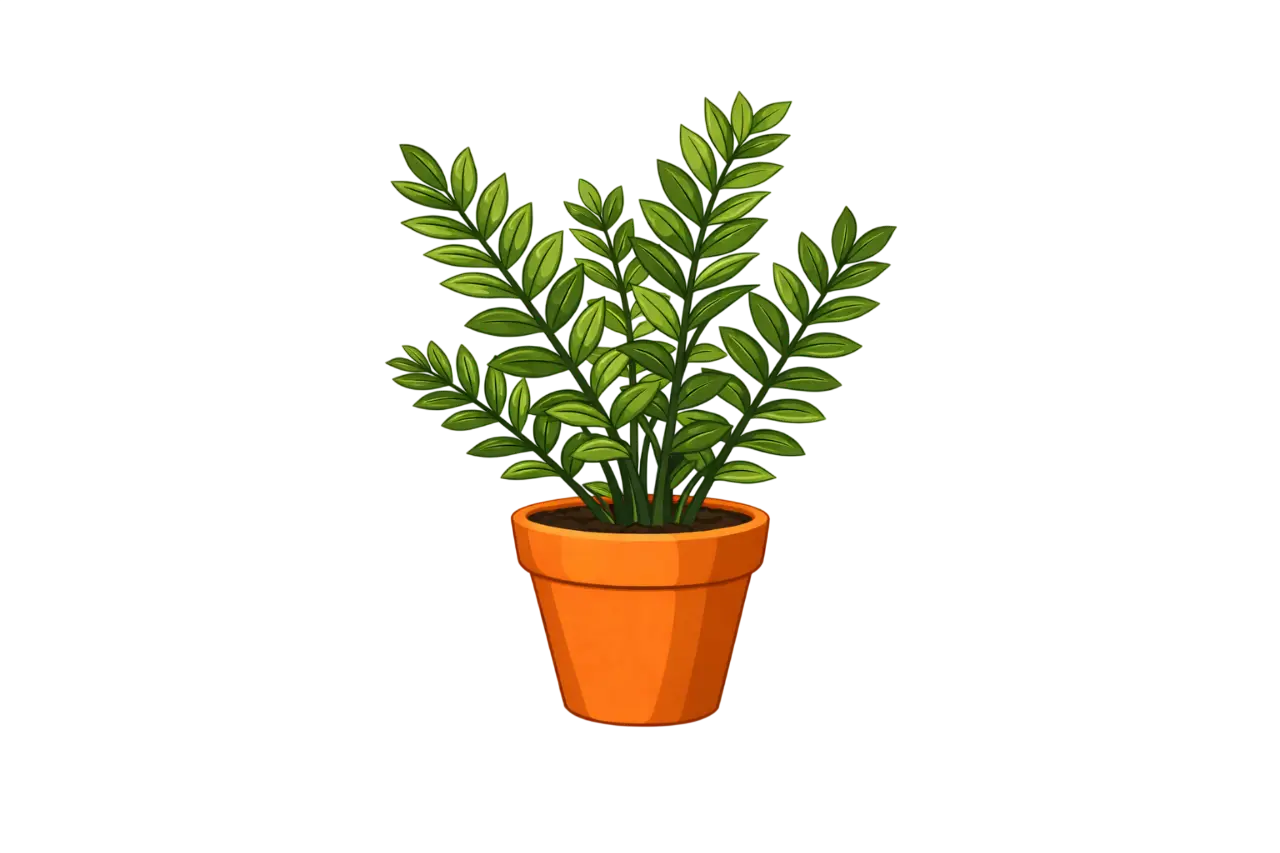
That habitat is dry grassland and woodland in eastern Africa, which Missouri Botanical Garden describes plainly and Clemson places from Kenya to South Africa in arid open savannah woodland. NC State lists Kenya, KwaZulu-Natal, Malawi, Mozambique, Tanzania and Zimbabwe. The plant is stemless. What looks like a stem is a single pinnately compound leaf rising straight out of a water-storing rhizome, carrying 6 to 8 pairs of glossy leaflets up to 6 inches long by MOBOT’s count. It all adds up to one of the better entries on any list of houseplants that are hard to kill.
Two things follow from that anatomy, and they catch people out. You cannot prune a ZZ plant into shape, because there is no stem to cut back to: you remove whole leaves at the base and wait for the rhizome to send up replacements, which at NC State and Clemson’s stated growth rate of slow to very slow takes a while. And the black spots that appear on those upright stalks are normal, which Clemson says outright. People scrub at them or throw plants out over cosmetic marks.
Quick Info
- LightLow
- WaterLow
- Size2-4 feet tall and wide
- HumidityLow
- TempAbove 60°F (16°C); sensitive to cold
- FloweringYes
- TypeTropical
- Dog SafeNo
- Cat SafeNo
- Kid SafeNo
Is the ZZ Plant Toxic to Pets?
Pets: NC State rates the toxicity severity as medium, names calcium oxalate as the toxic principle, and lists diarrhea and vomiting if the leaves are eaten in quantity. Clemson lists the plant as not pet safe. The ASPCA database carries no entry under ZZ plant or Zamioculcas that I could find, so those two are the sources to go on.
Kids: Calcium oxalate crystals make every part unpleasant to chew, so keep it away from small children. Handling the plant is fine; wash your hands after cutting it.
ZZ Plant Care Guide
Light, and Tolerance Is Not Preference
NC State lists the ZZ plant as tolerating deep shade, meaning under two hours of direct sun down to none at all, as well as partial shade at two to six hours. Clemson agrees it can survive low light. Both also say where it does best, and it is not the dark corner: bright indirect light. Direct sun is the exposure to avoid, since NC State reports leaf scalding and Clemson says to keep it out of full sunlight.
Treat the shade tolerance as what it is, which is tolerance. The plant holds its leaves in a dim hallway for years and puts up almost no new growth. Move it into bright indirect light and it still grows slowly, just visibly. A grow light on a timer does the same job in a room with no usable window. The old claim that the ZZ is one of the few plants happy under office fluorescents is plausible and gets repeated everywhere, and I could not find an extension source that actually tests it.
Watering, Humidity and Misting
Clemson gives the clearest instruction published for this plant: water one to two times a month, and only after the potting medium has dried completely. MOBOT says water regularly but let the soil dry between applications and avoid wet soils, and NC State drops the frequency to monthly over winter. A moisture meter helps here mostly because the surface of a ZZ pot dries long before the root zone does.
The CAM research changes how you should think about a missed watering. A dry spell is a metabolic switch for this plant and not an emergency, and the recovery data shows it comes back out of that mode within days of being watered. There is no equivalent safety margin in the other direction. Rhizomes sitting in wet soil rot, and that is the one way most ZZ plants die.
No humidity management is required here. Clemson states the plant does well at regular indoor humidity levels, and no extension service or botanic garden sets a percentage target for it. A plant evolved for seasonal drought in African grassland is not short of humidity in your living room.
Skip the misting too. The leaves are thick and waxy, water sits on them instead of soaking in, and all you achieve is spotting on the gloss. Wipe them instead.
Mix, and the One Published Recipe
Clemson publishes an actual recipe, rare for an extension page: 50 percent peat moss or coir-based potting soil, 25 percent perlite and 25 percent sand. NC State describes the soil as high organic matter and sand with good drainage. If you would rather not mix anything, a standard houseplant compost cut with a third perlite gets you close enough.
Drainage matters more than the ingredients. A rhizome is a storage organ with no interest in extra water, so the pot needs a working hole and no saucer left full. Heavy, water-retentive mixes are what turn a plant that tolerates a month of drought into one with soft rhizomes.
Temperature, and an Unsourced Range
Keep it above 60°F. Clemson says the plant is sensitive to cold and should be kept above that mark, and MOBOT tells you to bring container plants indoors in autumn once temperatures begin to dip below 60°F. NC State puts it in USDA zones 9a to 10b, which rules out a winter spent outdoors anywhere that has a real one.
The 60 to 75°F range quoted all over the internet traces back to nobody in particular. No extension service or botanic garden commits to an indoor figure for Zamioculcas, so treat it as a sensible guess and not a specification. Ordinary room temperature suits it. What to avoid is specific: a cold draught from a door in winter, and a windowsill behind closed curtains on a freezing night.
Feeding, as Light as It Gets
Clemson’s recommendation is as light as it gets: feed once or twice during the growing season with a balanced fertilizer. That is it for the year. A plant growing this slowly cannot use much, and fertiliser it does not use stays in the pot as salts.
Feed in spring and summer and stop entirely over winter, when growth is at a standstill in most rooms. If you are unsure whether one is due, our fertilizer calculator has a slow-growing and low-light setting that names this plant specifically.
Repotting, Rarely and One Size Up
Rarely, and no source I checked publishes a frequency or a pot size step for this species, so treat what follows as judgement rather than citation. The plant grows slowly at every scale, including below ground, so a ZZ is usually content in the same pot for several years. The sign to watch for is rhizomes pressing visibly against the sides or lifting the plant out of the compost.
Go up one size and no further. Rhizomes that fill their pot are not under stress, while rhizomes surrounded by a large volume of damp new compost are, for the rot reason above. Spring is the sensible time, since the plant has the whole growing season to settle before winter.
Grooming, and Why You Cannot Prune It
There is nothing to prune in the usual sense. Each upright stalk is one leaf, so cutting halfway down leaves you with a permanently truncated leaf and no new growth from the cut. Take whole leaves off at soil level with clean snips when they yellow or get damaged, and let the rhizome replace them in its own time.
Wiping the leaves is the one grooming job worth doing regularly. Dust shows badly on a gloss this high, and the wipe is also how you find scale, the one pest NC State tells you to watch for on an otherwise trouble-free plant.
How to Propagate a ZZ Plant
Division is the fast route, and both NC State and MOBOT list it. Turn the plant out in spring, find where the rhizomes separate naturally, and pull or cut them apart so each piece has at least one leaf and a healthy section of rhizome with roots. Pot each division into the same free-draining mix, water once, and then leave it alone until the compost has dried.
Leaf cuttings also work and are the slower, stranger option. NC State and MOBOT both list leaf cutting as a method for this species. Pull a single leaflet off with its base intact, let the wound dry for a few hours, and press it upright into damp, gritty mix. What happens next is the odd part: the leaflet grows a small rhizome underground before it shows you anything above the surface.
Be clear-eyed about the timescale. No extension service or botanic garden publishes a rooting time for either method, and the figures circulating online are guesses. What is documented is the growth rate: NC State calls it slow, Clemson very slow. A leaflet cutting is a project measured in many months, not weeks. Division gets you a plant that already looks like a plant. That is where I would start. Keep the medium barely damp throughout. A rhizome forming on a cutting has the same intolerance of wet soil as a mature one. The commonest way to lose propagations of this plant is keeping them as moist as you would a pothos cutting.
Common ZZ Plant Problems
Yellowing stalks, usually with soft tissue at the base, mean the rhizomes have been wet too long. This is the standard way ZZ plants die, and the fix is to stop watering, check the rhizomes for softness, and repot into a drier mix if several have gone. Recovering an overwatered plant covers the salvage.
Black spots on the stalks are normal. Clemson states this plainly, and it saves a lot of unnecessary worry. Marks that are spreading, soft or sunken are a different matter; dry, flat, dark speckling on an otherwise firm stalk is just how the plant looks.
Almost no new growth is the species behaving normally, especially in low light. NC State calls the growth rate slow and Clemson calls it very slow. When a plant really has stopped growing deals with the cases worth investigating.
Pale, bleached or scorched patches come from direct sun. NC State reports leaf scalding, and the damage stays on that leaf, since replacement only arrives as a new leaf from the rhizome.
Small brown or white bumps on the stalks and leaflets are scale, which NC State singles out as the pest to watch on a plant with no other significant problems. Identifying houseplant pests walks through treatment.
Leaflets dropping after a cold night point at chilling, not at watering. Both Clemson and MOBOT draw the line at 60°F, so a plant left by a cold window or carried home in winter without a bag has a plausible reason to shed.
Lower leaflets yellowing one or two at a time on an otherwise firm plant is ordinary ageing, and leaves do not last forever even on this one. Several whole stalks going at once is the pattern that matters, and that is the yellowing that means something.
FAQs
Clemson gives one to two times a month, and only once the potting medium has dried completely. MOBOT says to water regularly but let the soil dry between waterings, and NC State drops to monthly in winter. The exact interval depends on your pot size, light and room, so the dryness test matters more than the calendar. Err on the side of waiting, because the rhizomes hold a reserve and wet soil is what kills this plant.
It will hold on in very low light, and it will not grow much. NC State lists the plant as tolerating deep shade, under two hours of direct sun down to none, while naming bright indirect light as where it performs best. In a windowless room you are preserving the plant rather than growing it, and a grow light on a timer fixes that cheaply.
Because that is what ZZ plants look like. Clemson states that black spots on the stems are normal. Dry, flat dark speckling on a firm stalk needs nothing done about it. Spots worth attention are the ones that spread, feel soft or sit in sunken tissue, which point at rot starting lower down.
Yes, treat it as toxic. NC State rates the severity medium, names calcium oxalate as the toxic principle, and lists diarrhea and vomiting if the leaves are eaten in quantity. Clemson lists it as not pet safe. I could not find an ASPCA entry for ZZ plant or Zamioculcas under any of its common names, so those two extension sources are what the rating rests on. Handling is fine; chewing is not.
Nearly always because it is a ZZ plant. NC State rates the growth rate slow and Clemson rates it very slow, and low light slows it further without doing any harm. If the leaves are firm, green and upright, nothing is wrong. Brighter indirect light is the only lever that reliably speeds it up, and even then you are looking at a new stalk now and then rather than a flush.
No, and this is the one piece of standard houseplant advice that does not transfer. Each upright stalk is a single compound leaf growing straight from the rhizome, so there is no stem to cut back to and no node to branch from. Cutting one halfway leaves a truncated leaf permanently. Remove whole leaves at soil level instead, and let the rhizome push up replacements.
It can, and you will probably never see it. NC State records that it rarely flowers and describes the bloom as a sheath-like green spathe wrapped around a white spadix, in cream, tan, green and white. It is an arum family flower, so think peace lily rather than anything showy, and it appears low down at the base of the plant rather than up among the leaves.
No. Clemson says it does well at regular indoor humidity, and nobody has published a figure to aim at. It evolved in dry eastern African grassland and woodland with seasonal droughts. Humidity is not what it is short of. Skip the pebble tray and the misting; the waxy leaves shed water anyway.