
Pothos (Epipremnum aureum), also known as Devil's Ivy, is one of the easiest houseplants to propagate, and one of the most rewarding. A single healthy vine can give you dozens of new plants over time, completely free. Golden Pothos, Marble Queen and every other variety root the same way. For light, watering, and soil tips, check out our Pothos Care Guide.
Methods of Propagation
There are five ways to propagate a Pothos:
1. Stem Cuttings in Water
- Best for: Beginners who want to watch roots develop
- Time: Roots visible in 1–2 weeks; ready to transfer at 4–8 weeks
2. Stem Cuttings in Soil
- Best for: Skipping the water-to-soil transition; stronger roots from the start
- Time: 4–6 weeks for established roots
3. Sphagnum Moss
- Best for: Strong root development before transplanting
- Time: 3–5 weeks for roots
4. Division
- Best for: Mature, bushy plants that need repotting anyway
- Time: Instant new plants
5. Layering
- Best for: Long trailing vines; no cutting required until rooted
- Time: 2–4 weeks
What You'll Need
- Sharp, clean scissors or pruning shears
- A healthy Pothos with several vines
- Glass jar or vessel (for water method)
- Small pots with drainage holes
- Well-draining potting mix (add perlite if needed)
- Sphagnum moss (for moss method)
- Optional: rooting hormone (helps with soil method, minimal effect on water rooting)
The Node: The Most Important Thing to Know
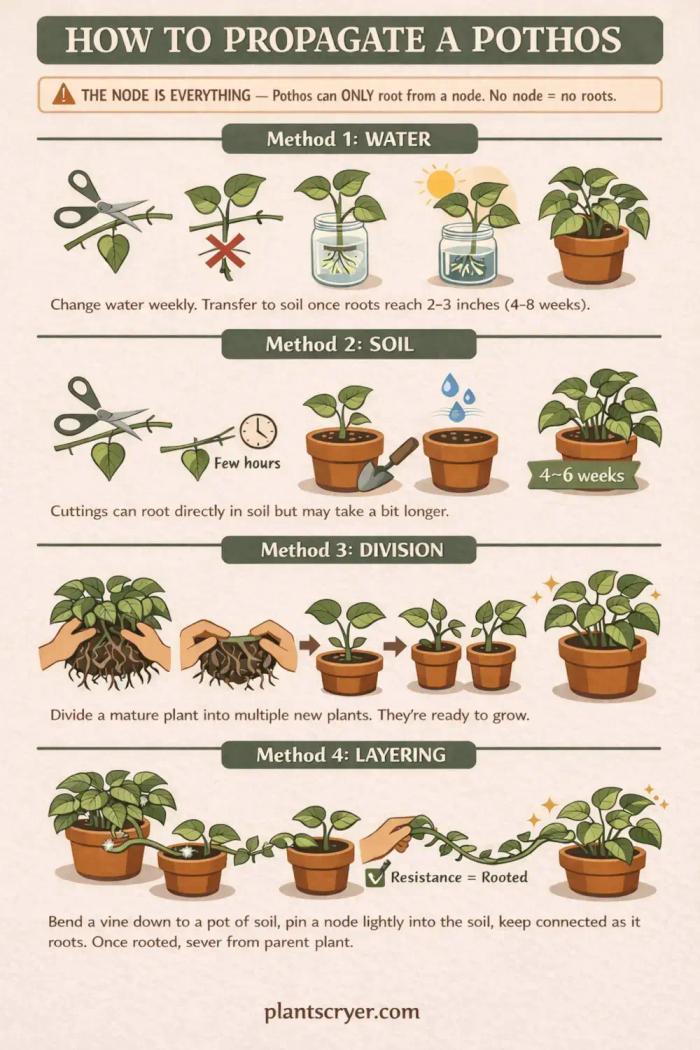
Unlike some houseplants, pothos can only root from a node: the small bump where a leaf meets the stem. No node means no roots, no matter how long you wait. Every cutting must include at least one. You may also spot aerial roots at the node, which look like small brown bumps or stubby growths. These are a bonus and will speed up rooting.
One more thing: cuttings taken from the tip of the vine will produce larger leaves than mid-vine cuttings. If leaf size matters, go for tip cuttings.
Propagation Methods
Method 1: Stem Cuttings in Water
- Select a healthy vine and locate a node.
- Cut just below the node using clean scissors: aim for 4–6 inches with 2–4 leaves.
- Remove any leaves that would sit below the waterline (submerged leaves rot).
- Place the cutting in a jar of water with the node submerged.
- Set in bright, indirect light.
- Change the water every 5–7 days to keep it fresh.
- Roots typically appear within 1–2 weeks. Wait until they reach 2–3 inches before transferring to soil: usually 4–8 weeks total.
Method 2: Stem Cuttings in Soil
- Take a cutting the same way as above: just below a node, 4–6 inches long.
- Optionally dip the cut end in rooting hormone to speed things up.
- Plant the cutting in well-draining potting mix, node buried just below the surface.
- Water lightly so the soil is moist but not soggy.
- Place in bright, indirect light.
- Roots develop in 4–6 weeks. Avoid pulling the cutting to check, as this disrupts growth.
Method 3: Sphagnum Moss
- Soak dry sphagnum moss in water for 20–30 minutes, then wring it out so it's damp but not dripping.
- Take a cutting with 2–3 nodes, removing lower leaves.
- Nestle the cutting into the moss so the nodes are in contact with it.
- Keep the moss consistently moist and place in bright, indirect light.
- Roots form in 3–5 weeks. Transplant to soil once roots are 2–3 inches long.
Method 4: Division
- Remove the entire pothos from its pot.
- Loosen the root ball gently with your fingers, working from the bottom up.
- Identify natural clusters of stems and separate them. Roots are tougher than they look and can handle some pulling.
- Rinse roots if needed to see the structure clearly.
- Replant each section in fresh, well-draining potting mix.
- Water lightly and keep in bright, indirect light. Growth resumes quickly.
Method 5: Layering
- Fill a small pot with moist potting mix and place it next to your parent plant.
- Select a long trailing vine and identify a node.
- Bend the vine so the node rests on the surface of the new pot's soil, then bury just the node under a thin layer of soil: leave the vine attached to the parent plant.
- Keep the soil in the new pot moist and wait 2–4 weeks for roots to form.
- To check for roots, give the vine a gentle tug: if it resists, it's rooted.
- Once rooted, cut the vine connecting it to the parent plant and grow it independently.
Tips for Success
- Always include at least one node per cutting. Without it, roots will never form
- Spring and summer are the best times to propagate; warmth significantly speeds up rooting
- Take multiple cuttings at once. Not all will succeed, and extras are cheap insurance
- Use a clear glass jar for water propagation so you can monitor root progress without disturbing the cutting
- Keep temperatures between 65–85°F (18–29°C) for best results
Common Problems When Propagating Pothos
- Cuttings rotting in water: Usually means leaves are submerged or the water isn't being changed frequently enough. Keep only the node underwater and refresh every 5–7 days.
- No roots forming: Check that your cutting has a node. It's the only place roots can grow. Also ensure the cutting is getting enough light and warmth.
- Roots forming but plant wilts after soil transfer: Normal adjustment stress. Keep soil evenly moist for the first few weeks while the plant adapts from water to soil.
- Soil cuttings collapsing: Overwatering is the usual cause. Let soil dry slightly between waterings and ensure good drainage.
- Roots growing very slowly: This usually means the temperature is too low or light too dim. Move cuttings somewhere warmer and brighter.
Frequently Asked Questions
How long does pothos propagation take?
In water, expect to see roots within 1–2 weeks, but wait until they're 2–3 inches long (usually 4–8 weeks) before transferring to soil. Soil and moss methods take 4–6 weeks for established roots. Division and layering produce rooted plants the fastest.
Do I need rooting hormone?
Not really. Pothos roots so readily that rooting hormone makes little difference for water propagation. It can give a modest boost for soil propagation, but is entirely optional.
Can I propagate a leafless cutting?
Yes. As long as it has a node. A bare node cutting (sometimes called a "wet stick") will eventually grow new leaves once rooted, but it takes longer since there are no leaves to drive photosynthesis.
Can I leave pothos in water permanently?
Pothos can survive in water long-term, but growth gradually becomes weaker and leaves thinner without soil nutrients. It works as a temporary display, but soil is better for long-term health.
Does this work for all pothos varieties?
Yes. Water, soil, moss, division, and layering all work the same way for Golden Pothos, Marble Queen, Neon, N'Joy, and every other variety.