How to Care for a Baby Rubber Plant
Peperomia obtusifolia
The reason this plant dies from kindness is written into the leaf. Howard Horner sectioned Peperomia obtusifolia leaves for Annals of Botany in 2012 and found that 75 percent of the leaf volume is multiple hypodermis, the water-storing tissue, while only 4 percent is palisade parenchyma, a single cell layer carrying the chloroplasts. The hypodermis acts as multi-layered window tissue, and calcium oxalate druses sitting in that thin green layer collect and disperse light to the chloroplasts around them.
So the leaf is mostly reservoir, with a narrow photosynthetic layer under a light-piping lid. It carries its own drought supply and has no tolerance for a wet root zone. That is the whole watering regime in one sentence.
It grows across tropical America, from Florida and Mexico through Central America and the Caribbean down to northern South America, in wet tropical forest, sometimes in the ground and sometimes as an epiphyte on a trunk. Indoors it stays small. Clemson gives 8 to 15 inches tall and wide, the RHS allows five to ten years to reach 25 centimetres, and the leaves are obovate, cupped and glossy at 2 to 6 inches long with pink or red tinged petioles. The species holds an RHS Award of Garden Merit from 2002. It has no botanical connection to the rubber plant, a fig in a different family; the shared name comes from leaf texture and nothing else.
One thing most care pages miss: it changes how it photosynthesises when water runs short. The species runs CAM-cycling alongside ordinary C3 photosynthesis and shifts further toward CAM under water stress. A dry spell is a mode switch for this plant, not an emergency, and that is the physiological reason underwatering is so hard to do and overwatering is so easy. The familiar claim that peperomia has a fine, thready, shallow root system demanding a chunky mix turns up everywhere and is sourced nowhere. The airy mix is still right. The reason is Phytophthora, covered below.
On safety there is nothing to worry about. The ASPCA lists Peperomia obtusifolia as non-toxic to dogs and cats under three separate entries, Baby Rubber Plant, Blunt Leaf Peperomia and Pepper Face, with no clinical signs recorded against any of them, and NC State extends that to horses. One small note if you go and check the ASPCA pages yourself: they print the family as Pipericeae, a typo for Piperaceae.
Quick Info
- LightMedium
- WaterLow
- Size8-15 inches tall and wide
- HumidityLow
- TempAbove 60°F (16°C), chilling damage below 50°F
- FloweringYes
- TypeTropical, Other
- Dog SafeYes
- Cat SafeYes
- Kid SafeYes
Is Baby Rubber Plant Toxic to Pets?
Pets: The ASPCA lists Peperomia obtusifolia as non-toxic to dogs and cats under three separate entries (Baby Rubber Plant, Blunt Leaf Peperomia and Pepper Face), with no clinical signs recorded. Its pages do not cover horses, but NC State rates the plant non-toxic for cats, dogs and horses.
Kids: No toxic principle is recorded, and no authoritative source reports irritant sap. The RHS species page carries no harmful note.
Baby Rubber Plant Varieties
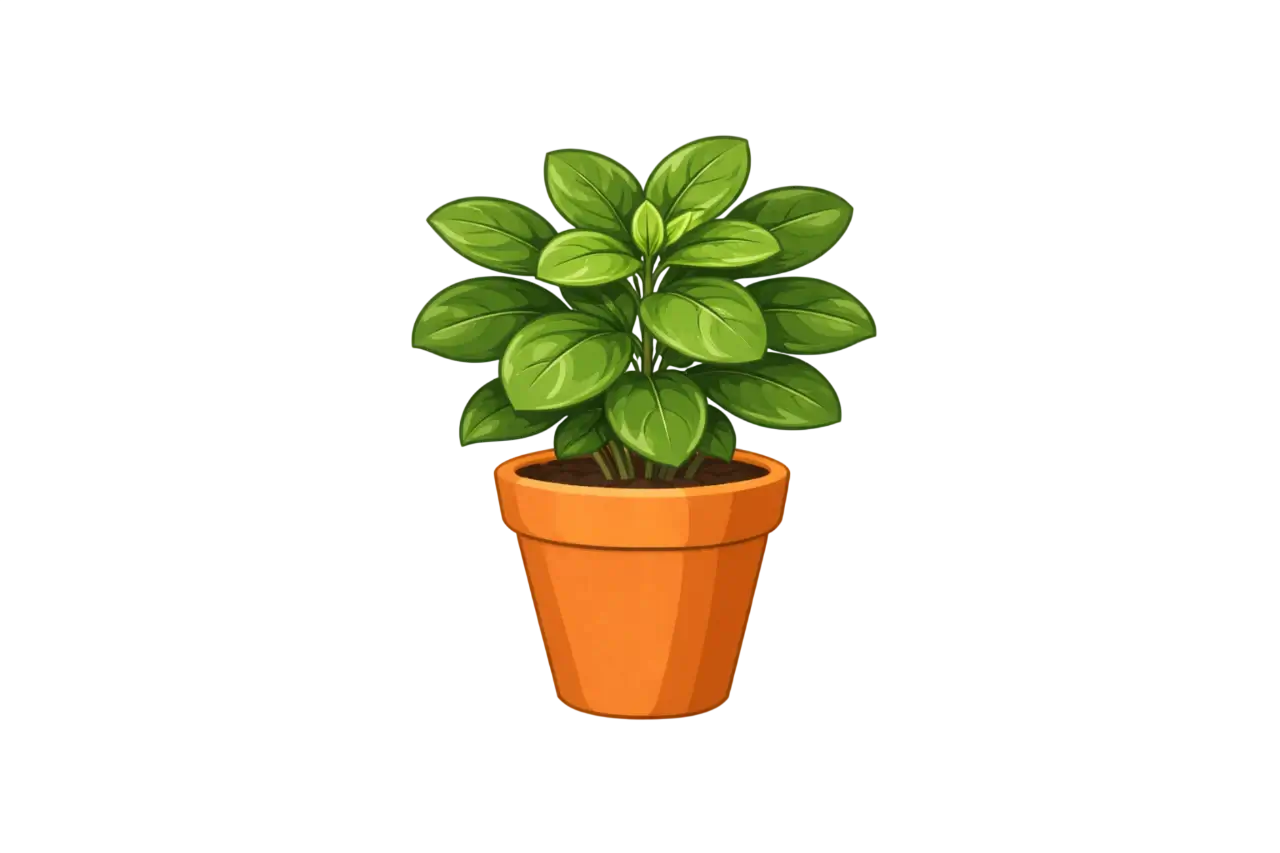
‘Variegata’, described by the RHS as a stiff, upright then spreading perennial to 25 centimetres tall, with leathery, elliptic, bright green leaves carrying wide yellow-green margins. This is the one most garden centres stock.
‘USA’, an evergreen perennial to 25 centimetres with broadly elliptic, leathery green leaves broadly margined in creamy-yellow. NC State also lists ‘Alba’, ‘Gold Tip’, ‘Minima’ and ‘Obtipan Green’, and the RHS adds ‘Golden Gate’, ‘Greengold’, ‘Albomarginata’ and Burning Bush.
A note on why labels disagree so much: the RHS files ‘Golden Gate’, ‘USA’, ‘Greengold’ and one ‘Variegata’ entry under Peperomia obtusifolia (Magnoliifolia Group), meaning the RHS itself treats much of the variegated trade material as a group straddling P. obtusifolia and P. magnoliifolia. Two nurseries can label the same plant differently and both have a case.
One name to treat with suspicion: ‘Marble’ appears on plenty of plant tags but is not listed by the RHS or NC State. It is trade usage, not a registered cultivar, so do not expect a published description to match what arrives.
Baby Rubber Plant Care Guide
Light, and What Burns It
NC State files it under dappled sunlight or partial shade, defined as direct sunlight for only part of the day, two to six hours. Clemson asks for bright indirect light at an east or south-facing window. Missouri Botanical Garden says part shade and specifically to avoid direct afternoon sun, and the RHS lists partial shade. NC State also notes it tolerates low light, so a north-facing room is a real option here and not a compromise you have to apologise for.
Too much direct sun burns the leaves, in NC State’s words, and scorches them in Clemson’s. The RHS gives a seasonal adjustment for the variegated forms worth copying: bright indirect light while the plant is in growth, moving into fuller light over winter. One claim does not survive checking: that low light makes the variegated forms lose their pattern. Nothing authoritative says it about this plant, and the nearest extension statement of the kind concerns golden pothos.
Watering, and How People Kill It
Let the soil dry out between waterings. That is Clemson’s instruction and the single most useful sentence about this plant. NC State lists it as intolerant of wet soil and of very dry soil, and records its preference as dry soil, so you are aiming at the dry end of a narrow band without going to the extreme. Missouri Botanical Garden says water moderately and allow the soil to almost dry between waterings, reducing in cooler months. The RHS adds tepid, soft water, moderately in summer and sparingly in winter.
Overwatering is how people lose this plant, and the early signs are specific. NC State: overwatering is a big problem and causes the leaves to yellow. Clemson: if it is overwatered, it will drop its leaves.
After that you are into root rot, blackening of the stem at the soil line and corky bumps on the leaf undersides, all covered under problems below. Nobody at an extension service or botanic garden publishes a watering interval in days or a depth-of-dryness figure for peperomia, so the familiar "every 7 to 10 days" and "top 2 centimetres dry" lines are invented. A moisture meter beats a calendar on a plant holding this much water in its own leaves.
Mix, and the Disease Behind It
Clemson calls for a well-drained houseplant or cactus potting mix. NC State lists clay, loam and sand as workable textures at a neutral pH of 6.0 to 8.0 with good drainage, and MOBOT suggests a peaty mix. Any of them works as long as water leaves quickly, so a cactus and succulent mix is the shortcut, and it matches Clemson’s recommendation directly instead of by analogy.
The reason for an open mix is the disease, not the roots. University of Illinois Extension gives the control for Phytophthora rot on peperomia word for word: avoid overwatering and heavy, poorly drained soil mixes, water from below, and keep the soil on the dry side. Set that beside the plant’s habit of growing as an epiphyte in the wild and NC State’s note that it is intolerant of wet soil, and the case for drainage is complete without inventing anything about root anatomy. If you are not sure which problem you have in the pot, root rot and soil mould look different.
Humidity, and the Myth It Attracts
It does not want high humidity, and here the authoritative sources contradict most of the internet. NC State Extension lists Peperomia obtusifolia under medium to low relative humidity preferred. Clemson goes no further than saying it will benefit from a humidifier in winter. The RHS specifies no humidity requirement at all. The widely copied line that peperomia prefers high humidity traces back to Wikipedia, not to any extension service or botanic garden. Nobody has published a figure to aim at, so there is nothing to measure yourself against. Skip the cabinet, the pebble tray and the humidifier. When a baby rubber plant is unhappy, look in the pot first.
Feeding, and the Winter Stop
Clemson suggests a low-strength liquid fertilizer occasionally during the growing season, or a slow-release granular once per year. The RHS goes monthly from spring to summer with a balanced liquid feed. Nebraska Extension’s general figure for quick-release water-soluble products is every two months on actively growing plants. A balanced liquid feed at low strength, somewhere between monthly and every two months through spring and summer, satisfies all three.
Stop over winter. Nebraska’s reasoning is that short days and low light put some plants into rest, producing little new growth and needing little or no feed. Overfeeding has a documented symptom set from the same source: reduced growth, brown leaf tips, dead root tips and wilting, with a yellow to white crust on the soil surface, around the rim of clay pots or around the drainage hole.
The fix is to leach the pot with water equal to twice its volume, poured a little at a time until it runs out of the bottom and repeated until it is used up, then let the soil dry back to normal before watering again. If the question is whether a feed is due at all, our fertilizer calculator answers that from the plant type, the season and your last feeding date.
Temperature and Chilling Injury
UF/IFAS puts Florida foliage plants at risk of damage below about 50°F, with chilling injury occurring above freezing but below 46 to 54°F. Its symptom list is unusually specific: rapidly wilting leaves with water-soaked areas, sunken pits where cells have collapsed, accelerated ageing, increased decay as metabolites leak out and feed bacteria and fungi, reduced growth, and browning of the damaged areas once temperatures warm back up. Brief exposure is recoverable. Prolonged exposure is not.
The RHS rates the species H1B, a minimum of 10 to 15°C, and Clemson says to move it outdoors only once nights are consistently 60°F or higher, typically in May. Nobody publishes an ideal range for this species, so the 65 to 80°F figure repeated everywhere is a plausible guess with nothing supporting it. What you are left with is practical enough. Keep it above 60°F, off a cold windowsill in winter, and out of the airflow from an air conditioner.
Repotting, Rarely
Rarely. Clemson states it does not need repotting every year and can stay in the same pot for several years. The RHS allows five to ten years to reach ultimate height, so there is not much root growth to accommodate. Nobody publishes a pot size step or a season for this species. Nor does anything say it prefers being root-bound, which is a different claim altogether from needing repotting infrequently. The difference matters, because one version has you leaving a plant in a pot that has stopped draining.
When you do move it, keep the new pot modest and the drainage working, because a large volume of wet mix around a plant that drowns this easily is the worst thing you can hand it. UF/IFAS advises against repotting or fertilising for about four weeks after a plant moves into a new interior. That guidance is written for Epipremnum, not peperomia, but it addresses the same settling-in stress.
Pinching for a Fuller Plant
One pruning instruction here has a source attached, from Clemson: prune a stem above a leaf node so the plant will branch. That is how you get a full, bushy plant instead of a handful of long stems leaning out of the pot. The RHS lists pruning as not required, so this is shaping and not maintenance. The same approach works on Peperomia Hope and the other trailing peperomias.
Nothing needs protecting on your side. Nothing in the literature reports irritant sap, the RHS carries no harmful note, and both the ASPCA and NC State list the plant non-toxic. Use clean snips for the plant’s sake instead. Illinois Extension’s hygiene protocol for peperomia is to take cuttings only from known healthy plants, 6 to 12 inches above the soil line, and to steam-sterilise propagation boxes, pots, sand and soil mixtures.
How to Propagate a Baby Rubber Plant
Leaf cuttings with the petiole attached are the best-documented route, and Iowa State University Extension names peperomia explicitly in its leaf petiole cutting guide. Leave 1 to 1.5 inches of petiole attached to the leaf blade, or as much petiole as you have if the leaf came off short. Rooting hormone on the lower end is optional. Insert the petiole into the medium at a 45-degree angle, not straight down.
Perlite, sand, coarse sphagnum moss, vermiculite, peat moss or a blend of them all work as the medium, in clean, sterile containers with drainage, at least two inches deep. Keep the cuttings warm, in bright indirect light, under a plastic dome or bag for humidity, with rooting hormone if you want it. Roots form in three to four weeks.
Small plantlets form at the base of each petiole and appear in six to eight weeks, and once they are adequately rooted you can pot them into regular potting soil. Those are the only published timings for propagating this plant, and they belong to leaf petiole cuttings specifically.
Stem cuttings work as well. Clemson takes them at 3 to 5 inches and confirms that water propagation works for Peperomia obtusifolia in particular, which an extension service rarely states outright. No rooting time is published for stem cuttings anywhere, so do not borrow the three-to-four-week figure from the leaf method and expect it to hold.
The rule that matters more than any technique here concerns which plant you cut from. Illinois Extension reports that ring spot virus is commonly transmitted by taking cuttings from apparently healthy but infected plants, and the virus specifically affects Peperomia obtusifolia and its variegated form. Take material only from plants with no symptoms, cut 6 to 12 inches above the soil line, and sterilise your pots and medium. A plant that looks fine today can hand the virus to every cutting you take from it, and nothing cures it afterwards.
Common Baby Rubber Plant Problems
Leaves yellowing is the overwatering signal, and NC State names it directly: overwatering is a big problem and causes the leaves to yellow. Let the soil dry out before watering again, and check that the pot still drains. Yellow leaves across other plants runs through the causes that point somewhere else.
Leaves dropping is the same cause a step further on. Clemson’s version: if it is overwatered, it will drop its leaves. A plant shedding healthy-looking leaves has a root problem, not a light problem.
Concentric brown necrotic rings that disfigure the leaf, with the tissue over the brown lines sunken into narrow furrows and the ringed area paler than the healthy part, is ring spot virus. Young leaves may be cupped, curled or twisted and the plant may be stunted. Illinois Extension gives one instruction here: discard diseased plants when you first spot them, because they will not recover.
Small raised pimply areas on both leaf surfaces, worst underneath, starting darker green or water-soaked and later going brown, corky and sunken, is oedema, also sold to you as corky scab. Illinois left the cause open in 1988 and suspected a virus, while the Connecticut Agricultural Experiment Station calls it physiological and attributes it to overwatering during cool, cloudy weather. The moisture reading is the one you can act on.
Blackening on the stem at the soil line with the lower leaves drooping, then a stunted plant that wilts and dies, is Phytophthora rot from Phytophthora palmivora and P. nicotianae var. parasitica. On small plants it begins where the leaf blades touch the soil and girdles the stem with a black rot. Destroy affected plants, water from below, and keep the soil on the dry side.
Cuttings with dark brown to black, water-soaked areas in the petioles at the soil line, often with decayed roots, is cutting rot. The same Phytophthora species are involved plus Rhizoctonia solani and Pythium, and the control is sterile pots and sterile medium, not anything you can spray.
Brown leaf tips alongside a yellow or white crust on the soil surface, the pot rim or the drainage hole is fertiliser salt buildup, according to Nebraska Extension. Leach the pot with twice its volume of water and ease off the feeding.
Scorched or burned patches come from too much direct sun, which both Clemson and NC State name. Pull it back from the glass or hang a sheer curtain, and leave the damaged leaves where they are for now.
Long bare stems with widely spaced leaves is a shape problem, not a disease. Clemson’s fix is to prune a stem above a leaf node so the plant branches out from that point. For pests, NC State reports no serious problems but suggests monitoring mealybugs, spider mites and whiteflies, and Clemson adds scale and fungus gnats.
FAQs
No, and the two are not even distant relatives. Peperomia obtusifolia belongs to Piperaceae, the pepper family, while the rubber plant is Ficus elastica in the fig family. The shared name comes from the thick, glossy, rubbery leaf texture. Care differs in the way that matters most too, since the fig wants steady moisture and this plant wants to dry out between waterings.
There is no interval to give you, and any page that offers one is guessing, because no extension service or botanic garden publishes a figure in days for peperomia. Clemson says to let the soil dry out between waterings, and NC State records the plant as preferring dry soil while being intolerant of both wet soil and very dry soil. The leaf is 75 percent water-storage tissue, so it carries its own buffer. Underwatering is hard, overwatering is easy.
No. NC State Extension lists Peperomia obtusifolia under medium to low relative humidity preferred, and the RHS specifies no humidity requirement at all. Clemson goes only as far as saying it will benefit from a humidifier in winter. No authoritative source sets a percentage target for this plant, so there is nothing to aim at and no benefit to a pebble tray or a cabinet.
Yes, and Iowa State University Extension names peperomia in its instructions for doing it. Keep 1 to 1.5 inches of petiole attached to the leaf, insert it into the medium at a 45-degree angle, and keep it warm and humid in bright indirect light. Roots form in three to four weeks, and small plantlets appear at the base of the petiole in six to eight weeks.
Overwatering, in almost every case. NC State states it plainly: overwatering is a big problem and causes the leaves to yellow. Clemson adds that an overwatered plant will drop its leaves as well, so yellowing followed by leaf loss is the same problem progressing. Let the soil dry back and check that water actually leaves the pot.
That is oedema, also called corky scab. The bumps start as darker green or water-soaked blisters, worst on the undersides, and later turn brown, corky and often sunken. The cause is not fully settled: the University of Illinois left it open in 1988 and suspected a virus, while the Connecticut Agricultural Experiment Station calls it physiological and ties it to overwatering during cool, cloudy weather. Manage soil moisture carefully in low light and the bumps stop appearing on new leaves.
It tolerates low light, which NC State states directly, so a north-facing room is workable. Its preference is partial shade or dappled sunlight, meaning two to six hours of direct sun, or bright indirect light at an east or south window in Clemson’s version. What you give up in low light is pace, not health, and the species is only a medium grower even in good conditions.
Yes. The ASPCA lists Peperomia obtusifolia as non-toxic to dogs and cats under three separate entries, Baby Rubber Plant, Blunt Leaf Peperomia and Pepper Face, with no clinical signs recorded. The ASPCA pages do not mention horses, but NC State rates the plant non-toxic for cats, dogs and horses. No source reports irritant sap either, so handling it is fine.