
How Often to Water a Golden Pothos

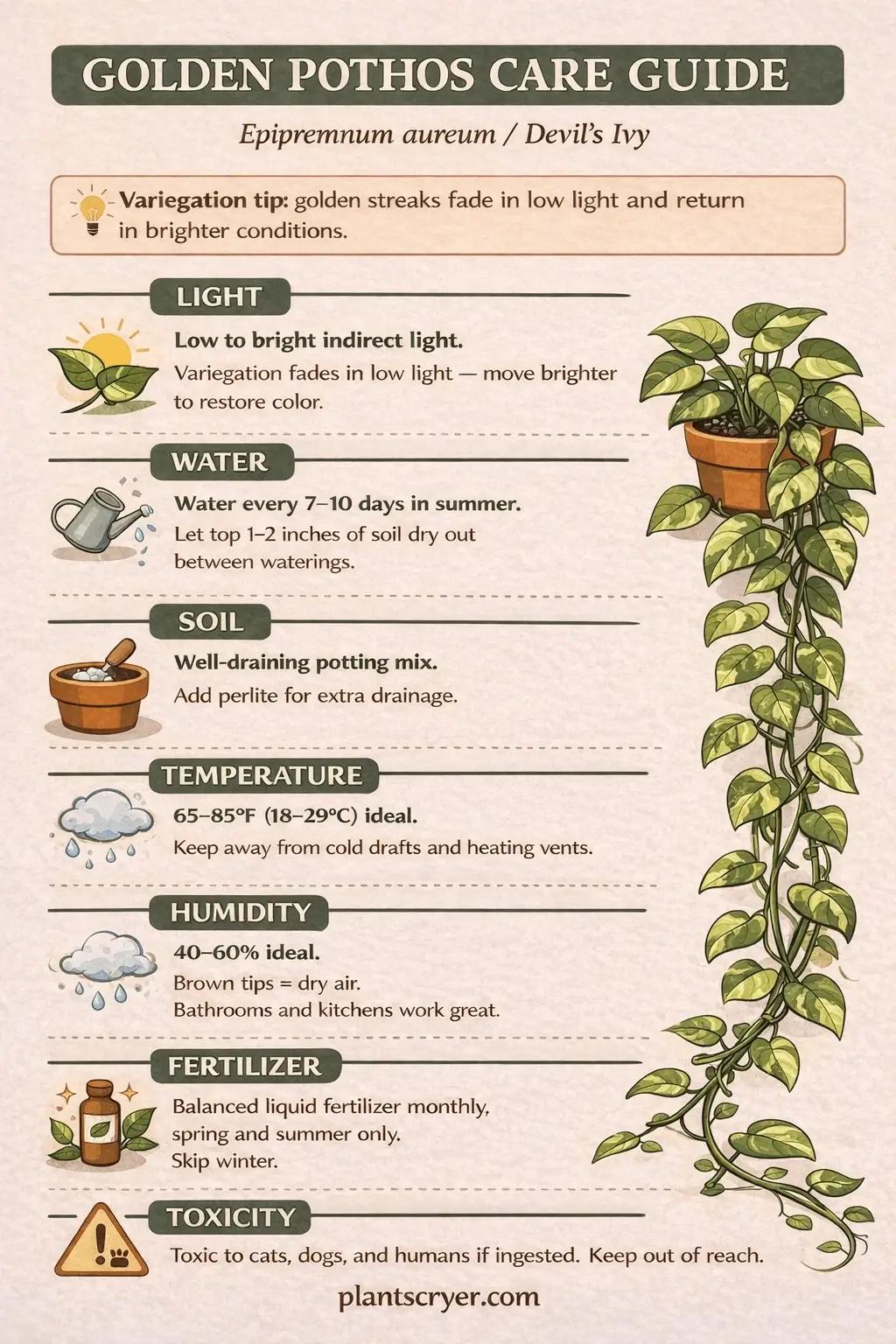
Golden Pothos needs water every 7 to 10 days in spring and summer, and every 14 to 21 days in winter. Of all the common houseplants, it’s one of the most forgiving of drought — a missed watering rarely causes lasting damage. Overwatering is a different story. Root rot from consistently wet soil is the main way people kill this plant, and it can move fast.
Frequency isn’t fixed though. How often you actually water depends on your light level, pot type, and time of year. There’s one variable specific to golden pothos worth understanding: in low light the leaves gradually shift toward solid green as the plant produces more chlorophyll to compensate. If you’ve moved your plant to a brighter spot to keep the golden colour, the soil will dry out faster and you’ll need to water more often. The plant effectively trades watering frequency for better looks. The sections below explain how to work with that, along with a calculator to find your specific schedule.
Find Your Watering Schedule
Light Level
Season
Pot Material
Pot Size
Humidity
Adjust the inputs for your light level, pot size, and current season. The result is a starting interval — fine-tune based on how quickly your soil actually dries out over the first few cycles.
What Actually Determines How Often You Water
Light level and variegation
Golden pothos is one of the more forgiving variegated plants when it comes to low light — it holds its colour better than Marble Queen or Snow Queen in dim conditions. But in genuinely low light, it still produces more chlorophyll and the leaves gradually fade toward solid green. Many owners move the plant closer to a window to reverse this, which is the right call for appearance, but brighter light means the soil dries out faster. A plant near an east-facing window may need water every 7 days. The same plant in a dim corner could go 14 days without issue. If you’ve recently moved your golden pothos and it seems to need water more often than before, that’s why. Adjust how often you check rather than how much you water.
Season
Golden pothos grows actively through spring and summer and uses noticeably more water during those months. In winter, growth slows and the plant becomes genuinely drought tolerant. Going 3 weeks between waterings in a cool, low-light room is completely normal. Don’t feel like you need to water just because a week has passed.
Pot type and material
Terracotta wicks moisture out of the soil passively, so the root zone dries faster. If you tend to overwater, a terracotta pot is one of the simplest ways to reduce root rot risk without changing anything else about your routine. Plastic and glazed ceramic hold moisture longer, which is fine as long as you’re checking soil moisture before watering rather than going by a fixed schedule. If you travel or just want fewer things to remember, a self-watering pot keeps moisture consistent without the risk of standing water pooling underneath. Whatever material you use, drainage holes are not optional.
Vine length and pot size
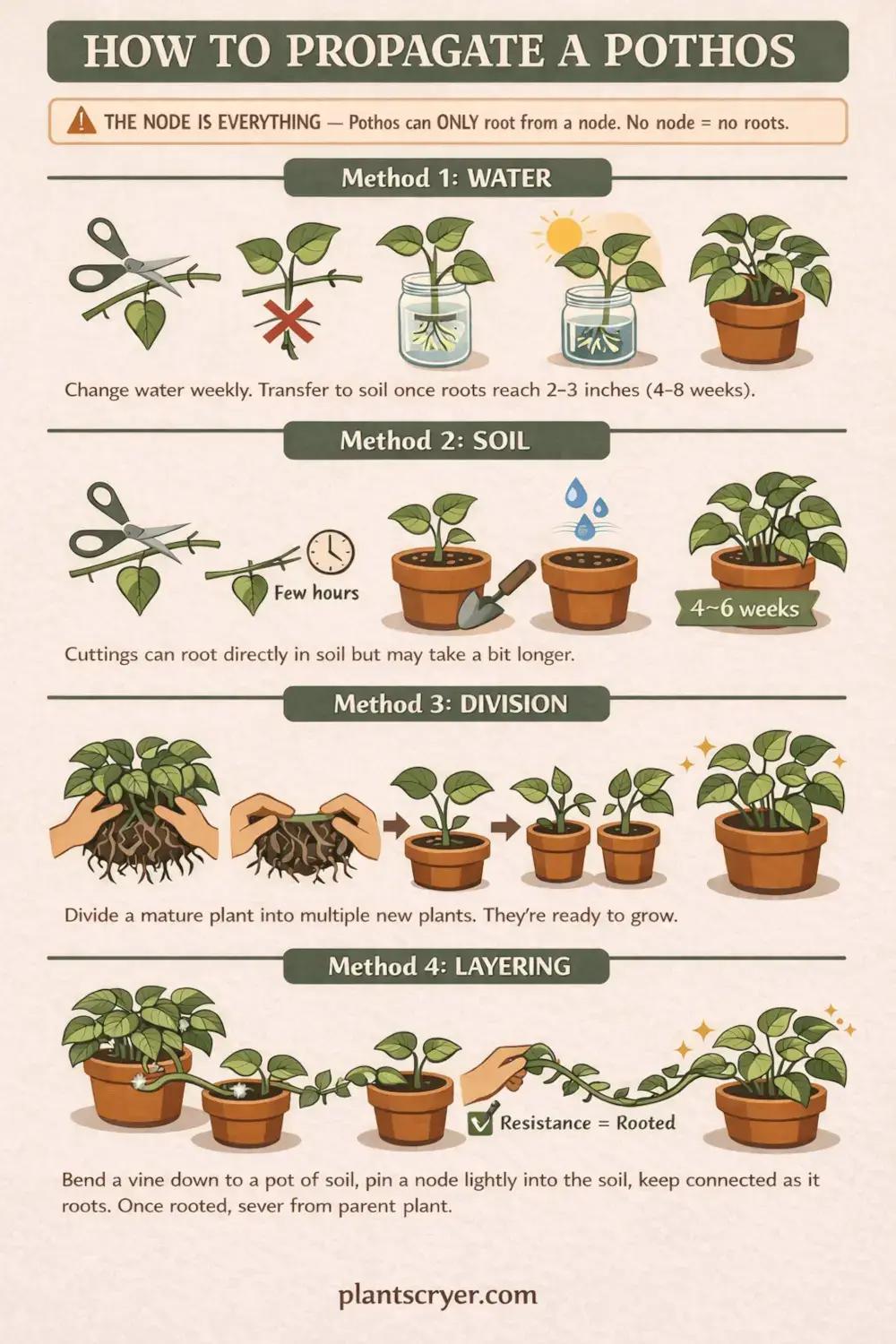
A small golden pothos in a 4 inch pot dries out much faster than a mature trailing plant in an 8 inch pot with a well-established root system. More soil volume holds more moisture. If your plant seems to need water every couple of days despite thorough watering, check whether it’s rootbound — when roots have taken over the whole pot there’s barely any soil left to hold moisture, and the plant dries out within days of watering. See the care guide for repotting guidance, and check out the propagation guide if you want to use those long trailing vines to start new plants.
Humidity
Dry air speeds up evaporation from the soil surface, so in a dry heated room in winter your pothos may need water more often than you’d expect despite growth having slowed. Humid rooms like bathrooms and kitchens naturally extend intervals a little.
How to Tell When Your Golden Pothos Needs Water
- Finger test. Push your finger into the soil to the first or second knuckle, roughly 1 to 2 inches deep. Golden pothos likes to dry out more thoroughly between waterings than peace lily does. If it still feels even slightly damp at that depth, wait another day or two. Erring on the dry side is almost always the right call with this plant.
- Pot weight. Lift the pot right after watering to learn what fully saturated feels like, then lift it a few days later. A noticeably lighter pot is a reliable sign it’s time. This becomes intuitive quickly and is the fastest daily check once you’ve calibrated it.
- Leaf curl. Golden pothos leaves curl slightly inward at the edges when the plant is getting thirsty. This happens before any wilting or drooping, making it an earlier signal than most people realise. If you catch the curl, water thoroughly and the plant usually recovers within a few hours.
- Moisture meter. If you want a more precise read without the guesswork, a soil moisture meter removes the uncertainty. Particularly useful while you’re still calibrating to a new plant or a new spot in your home.
Golden Pothos Watering Schedule by Season
Spring and summer
Check the soil every 5 to 7 days and water when the top 1 to 2 inches feel dry. Most golden pothos in average household light land in the 7 to 10 day range. Plants in bright spots near windows may need water closer to weekly. New leaf growth and firm, glossy vines are signs the schedule is working.
Fall
Growth begins to slow in September and October. Start stretching your intervals and let the soil dictate timing. The shift from summer to winter frequency is gradual — don’t cut watering in half overnight, just start checking every 8 or 9 days instead of every 5.
Winter
Every 14 to 21 days is a normal range, but always check before watering. A golden pothos in a warm bright room might still want water every 10 to 12 days. One in a cool dim corner can go 3 weeks without any sign of stress. When in doubt, wait another few days.
How to Water a Golden Pothos
Water slowly and thoroughly until it runs from the drainage holes, then empty the saucer. Never let the pot sit in standing water between sessions.
One situation that comes up more often with pothos than most houseplants: if the soil has gone very dry and water runs straight through without soaking in, the mix has become hydrophobic. This happens because pothos tolerates longer dry periods than most plants, and peat-heavy mixes can repel water once they’ve fully dried out. Fix it by bottom watering — put the pot in a few inches of water for 20 to 30 minutes and let the root ball rehydrate slowly from below. Once the soil feels uniformly moist, drain thoroughly and go back to normal top watering. When you next repot, mixing in some perlite keeps the soil structure more open and reduces how often this happens.
Room temperature water only. Cold water can temporarily slow root activity.
Signs You’re Getting It Wrong
Yellow leaves on golden pothos almost always mean overwatering, not underwatering. This is the most common misdiagnosis — owners see yellow leaves, assume the plant is thirsty, water more, and make things worse. If the soil is wet and leaves are yellowing, stop watering and let the soil dry fully before the next session.
Explore more golden pothos guides
Frequently Asked Questions
Every 14 to 21 days is a normal range, but check the soil first. Going 3 weeks without water in a cool, low-light room is completely fine. When in doubt, wait a few more days.
Yellow leaves almost always mean overwatering. Check the soil — if it has been consistently damp, cut back your watering frequency and let the top 2 inches dry out fully before the next watering. Make sure the pot has drainage holes and nothing is blocking them. Occasionally a few yellow leaves on older lower vines are just natural aging and nothing to worry about.
Fading variegation is a light problem. In low light, golden pothos produces more chlorophyll and the golden patches gradually shift toward solid green. Move it closer to a window with bright indirect light. Keep in mind that once a leaf has reverted, it won't change back — but new growth in better light should come in with better colour. Once you move it to a brighter spot, also expect to water a bit more often as the soil will dry out faster.
Yellow leaves and soil that stays wet for more than a week after watering are the clearest signs. Lift the pot a few days after watering — if it still feels heavy, it is not drying out fast enough. Check that drainage holes are clear and the saucer is not holding standing water underneath.
Yes, regularly in winter and often in autumn too. Golden pothos stores water in its stems and tolerates dry soil better than most common houseplants. In a cool low-light room in winter, two to three weeks between waterings is completely normal.
Not inherently. Golden pothos actually handles lower light better than heavily variegated varieties like Marble Queen, which means it does not always need to be in as bright a spot. That said, if you are keeping yours in bright indirect light for colour reasons, it will dry out faster than a jade pothos sitting in a dimmer corner. It is less about the variety and more about where you are keeping it.