
Why Is My Golden Pothos Leggy?
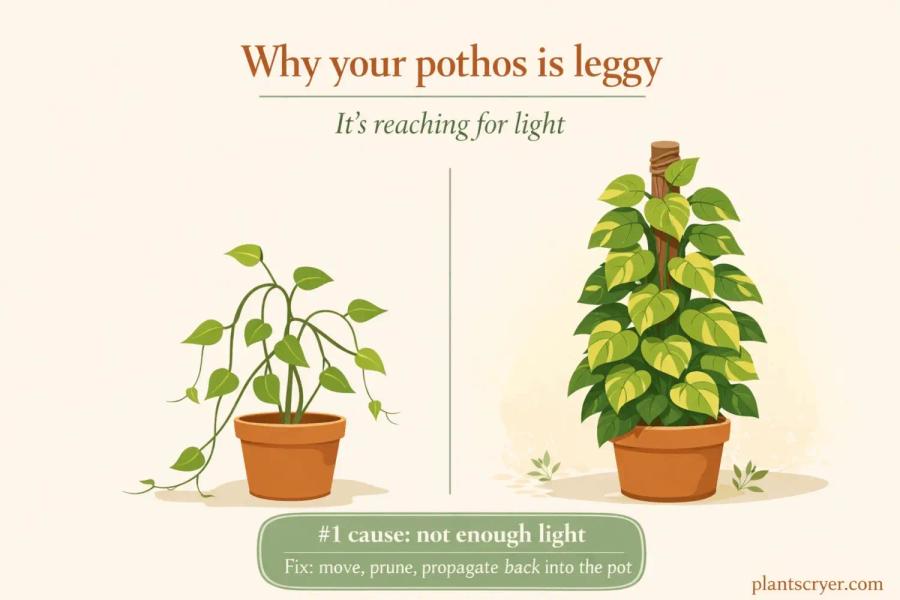
Leggy golden pothos is almost always a light problem. The plant stretches its stems toward the nearest light source, internodes get longer, and new leaves come in smaller. The result is long, bare-looking vines with widely spaced foliage that looks thin compared to the dense growth you probably bought.
Before you reach for the scissors, look at where the leggy growth starts. If the entire plant is leggy from the pot outward, light is the cause. If it was full near the pot but thinned out further along the vines, you are looking at natural leaf drop from age or lack of pruning. That distinction tells you whether to move it or cut it back — or both.
Leggy All Over vs Leggy at the Tips: Start Here
Leggy all over, from the base outward — insufficient light. The plant has been stretching since it was placed in its current spot. Internodes are long and leaves are small along the entire length of every vine.
Full near the pot, bare further out — the plant grew well initially but older leaves dropped over time as the vines extended, or it was never pruned. The growth near the pot was produced when light and energy were available; the bare sections formed as the vine grew beyond its light reach or simply aged out.
If your plant is leggy all over from the base, start with causes 1 and 3. If it was full near the pot but bare further out, start with causes 2 and 5.
1. Insufficient Light
This is the most common cause by a wide margin. Golden pothos tolerates low light but it does not grow well in it. In dim conditions the stems elongate as the plant reaches toward whatever light is available. Internodes — the bare sections of stem between each leaf — stretch longer, new leaves come in smaller, and the golden variegation fades toward solid green because the plant needs more chlorophyll to compensate for the reduced light. The effect is cumulative. A plant in moderate light might look fine for months before the legginess becomes obvious. By the time you notice it, several feet of stretched growth have already formed and that growth will not shorten or fill in on its own.
- Long spaces between leaves along the entire vine, starting from the base
- New leaves noticeably smaller than older ones
- Variegation reduced or absent on recent growth
- Plant is more than 6 to 8 feet from a window or in a room with minimal natural light
Move to bright indirect light — within 3 to 6 feet of a window that gets good daylight, or directly in front of a north-facing window. The existing stretched growth will not shorten or fill in; you need to prune it back and let new compact growth replace it. A full-spectrum grow light running 10 to 12 hours daily works well in windowless rooms or dark corners where a window move isn’t possible.
2. Never Pruned
Golden pothos is a vine. Without regular pruning, each stem grows longer and longer while the plant channels energy toward the growing tips rather than maintaining older leaves. Over time, lower leaves yellow and drop naturally, leaving bare sections of stem closest to the pot while all the foliage clusters at the vine ends. This is normal vine behaviour, not a sign that something is wrong with the plant. But it is the single biggest reason pothos plants go from looking full and bushy at the garden centre to thin and stringy within a year or two of coming home.
- Vine is full and leafy at the tips but bare for several inches or feet near the pot
- Older lower leaves have yellowed and dropped over time
- Plant has not been trimmed since purchase
- Light conditions are adequate — the problem is vine length, not stretching
Cut each vine back to just above a node (the small brown bump where a leaf attaches or once attached). The plant will branch from the cut point, producing two or more new growing tips instead of one. This is the single most effective fix for leggy pothos. Root the cuttings in water and plant them back in the same pot for immediate density. See the full pothos propagation guide for step-by-step instructions. Use clean, sharp pruning snips to make clean cuts that heal faster.
3. Trailing Without Support (No Climbing Structure)
Golden pothos is a climbing aroid in the wild, using aerial roots to attach to tree trunks and climb toward the canopy. When given something to climb, leaf size increases significantly — mature climbing pothos can produce leaves two to three times larger than trailing ones, with shorter internodes between them. Without support, the plant defaults to a trailing habit with smaller, more widely spaced foliage. This is not damage or poor care. It is a growth mode difference. But if your pothos looks sparse and the leaves seem small for the plant’s age, the lack of a climbing surface is often the missing piece.
- Plant is hanging or trailing over a shelf edge with nothing to climb
- Leaves have stayed small relative to the age and length of the vines
- Aerial roots are visible along stems but not attached to anything
- Internodes are not unusually long — the vine just looks sparse because leaves are small
Give the plant something to climb. A moss pole, coir pole, or even a bamboo support secured in the pot works. Guide the vines upward and use soft plant ties or clips to hold them against the support until the aerial roots attach on their own. New growth produced while climbing will have noticeably shorter internodes and larger leaves. Keep the moss pole damp to encourage root attachment.
4. Nutrient Deficiency
A pothos that has not been fertilized in months or years produces smaller, paler leaves on longer, thinner stems. The plant extends vine length because it is searching for resources, but each new leaf gets less investment because there is not enough available nutrition to build full-sized foliage. This shows up most often in plants that have been in the same soil for over a year without any feeding. Potting mix depletes over time, and a pothos in exhausted soil can look leggy even in good light.
- Leaves getting progressively smaller along the vine despite adequate light
- Pale or washed-out colour on new growth
- Plant has not been fertilized in 6 or more months
- Same soil for over a year without repotting
Resume feeding with a balanced liquid fertilizer at half strength every 2 to 4 weeks during spring and summer. If the soil is old and compacted, repot into fresh potting mix to restore both structure and nutrient availability. New growth should come in larger and closer together within a few weeks of consistent feeding.
5. Leaf Drop From Stress
Sometimes a pothos looks leggy not because the growth pattern changed but because it lost leaves along otherwise normal stems. Overwatering, severe underwatering, pest damage, and cold drafts can all cause leaves to drop, leaving bare patches mid-vine that look like legginess. The distinction matters because the fix is different. Leggy growth from low light means the internodes themselves are stretched too long. Leaf drop on normal-length internodes means the spacing was fine but the leaves are now missing. Look closely at the bare sections — if the nodes are close together and you can see the scars where leaves once attached, leaf drop is the cause rather than etiolation.
- Bare sections of stem with short, normal-length internodes (not stretched)
- Leaves dropped at random points along the vine, not only at the base
- Recent history of inconsistent watering, cold exposure, or visible pests
- Leaf scars visible at the nodes where leaves once attached
Identify and correct the underlying cause first. Once conditions stabilise, the bare sections will not regrow leaves — pothos does not produce new foliage from old nodes. Prune back to a node with a healthy leaf and let the plant regrow from there. For longer vines with patches of good growth, try layering: pin bare stem sections against moist soil in the same pot using hairpins or clips, and roots will form at the nodes to create new growth points without separating the vine.
Quick Diagnosis Guide
Frequently Asked Questions
The most common cause is insufficient light. Pothos tolerates low light but stretches toward the nearest light source when there is not enough, producing long internodes and smaller leaves. Move to bright indirect light and prune back the stretched growth — it will not fill in on its own.
Prune each vine back to just above a healthy node. The plant branches from the cut point, producing two or more new growing tips instead of one. Root the cuttings in water until roots reach 1 to 2 inches, then plant them back in the same pot for immediate density. Regular pruning every 3 to 6 months prevents the bare-stem problem from returning.
No. Stretched internodes are permanent — they will not shorten and new leaves will not appear between existing ones. You need to cut back the leggy growth so the plant can regrow with compact, shorter internodes from the pruned point. Improve light before pruning so the regrowth comes in dense rather than repeating the same problem.
Yes. When golden pothos climbs a support structure like a moss pole, it produces larger leaves with shorter internodes compared to trailing growth. This is the plant’s natural climbing habit and results in noticeably denser, fuller foliage. Keep the moss pole damp to encourage the aerial roots to attach.
Within 3 to 6 feet of a window that receives good daylight for the densest growth. Beyond 6 to 8 feet the plant will gradually stretch and become leggy, even though it may survive for a long time. A north-facing window works if the plant sits directly in front of it. East-facing windows provide gentle direct morning light that pothos handles well.
Yes. Cut vine sections with at least one node and one leaf, root them in water until roots reach 1 to 2 inches, then plant in soil. Cuttings from leggy vines root just as reliably as cuttings from compact growth. Planting multiple rooted cuttings back in the original pot is the fastest way to restore a full, bushy look.
Every 3 to 6 months keeps the growth compact and prevents the bare-stem cycle. More frequent light pruning is better than occasional heavy cuts, though pothos handles aggressive pruning well and regrows quickly from cut points even if you take the vines all the way back to a few nodes.
For the full care routine including watering, light, and feeding, see the golden pothos care guide.