
How Often to Water a Dieffenbachia

Dieffenbachia needs water roughly every 7 to 14 days during the growing season, but that range shifts considerably depending on your pot, light level, and time of year. A small plant in a terracotta pot near a bright window will dry out much faster than a large plant in plastic sitting in a dim corner.
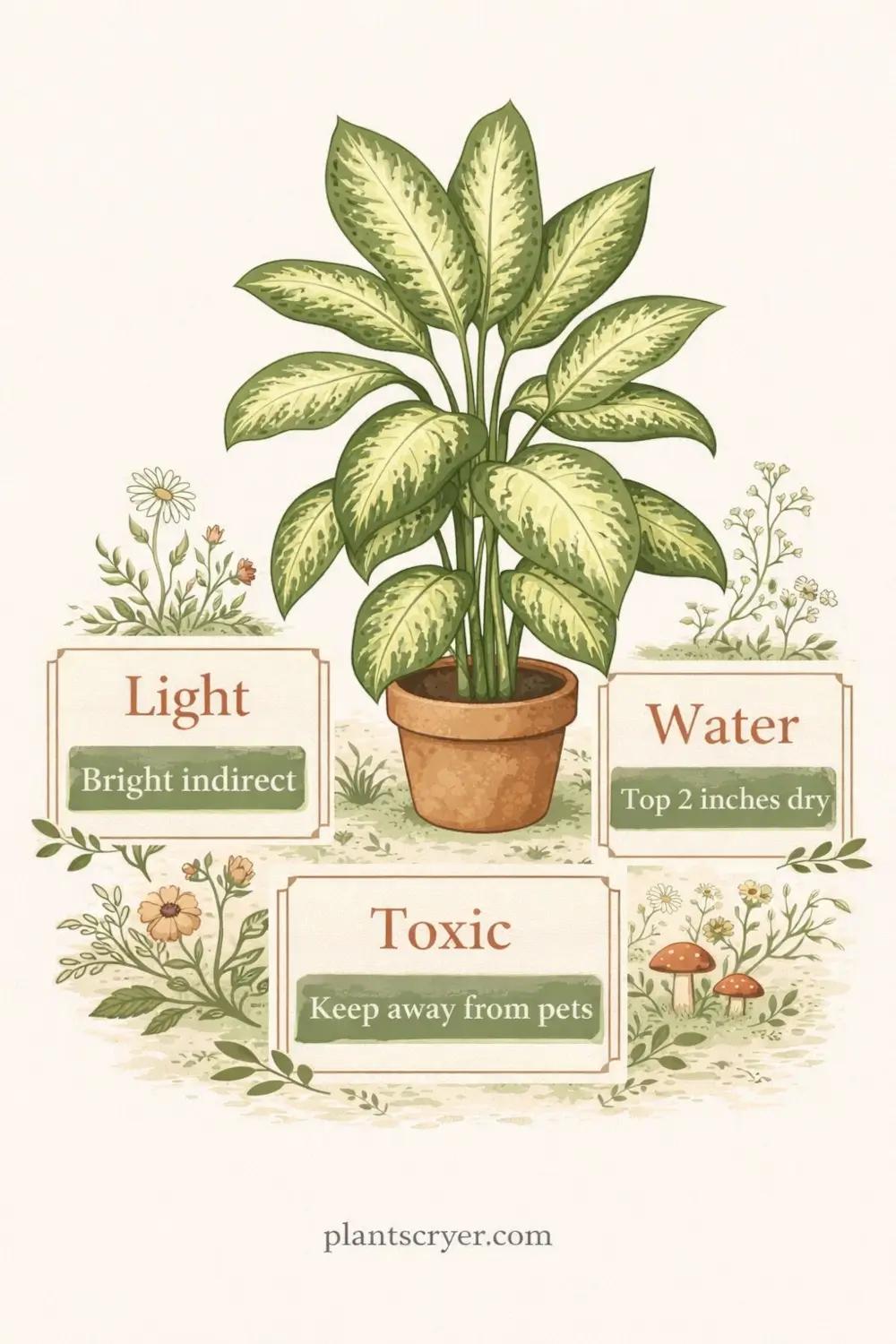
Unlike succulents, Dieffenbachia does not want to dry out completely between waterings. It prefers consistently moist soil: not wet, not bone dry. Letting it go too long causes dramatic drooping; keeping it too wet causes root rot. The finger test is the most reliable check: push your finger into the top one to two inches of soil. If it feels dry at that depth, it’s time to water. If it still feels damp, wait.
Your Dieffenbachia Watering Interval
Pot Size
Pot Material
Light Level
Season
Humidity
Adjust the inputs for your pot size, material, light level, and current season. The result gives you a personalised starting interval: treat it as a baseline and fine-tune it based on how quickly your soil actually dries out.
Pot, Light and Season: What Moves the Number
Pot material changes your schedule more than you’d expect
Terracotta is porous and pulls moisture away from the soil continuously through the pot walls. A Dieffenbachia in terracotta will need water noticeably sooner than the same plant in plastic or glazed ceramic, sometimes several days sooner. If you tend to overwater, terracotta is useful because it corrects the problem passively. If you already water conservatively, plastic or glazed ceramic reduces the risk of the soil drying out too fast in summer.
Light level determines how quickly the soil dries
A Dieffenbachia in bright indirect light is actively photosynthesising and transpiring water through its leaves. One sitting in a dim corner is doing very little, and the soil will hold moisture much longer. A plant in low light can go two to three weeks between waterings while one near a bright window may need attention every week in summer. Check the soil rather than watering on a fixed schedule.
Dieffenbachia slows down in winter but doesn’t go fully dormant
Unlike cacti or snake plants, Dieffenbachia doesn’t enter a hard dormancy in winter. Growth slows but the plant stays active at a reduced pace. Water less frequently in autumn and winter, roughly every 12 to 18 days rather than weekly, but don’t let the soil dry out completely the way you would with a succulent. Bone-dry soil for extended periods causes leaf drop and root dieback that’s slow to recover from.
The risk is real on both ends
Overwatering causes root rot: brown mushy stems at the base, yellowing leaves, soil that stays wet for weeks. Underwatering causes dramatic wilting that looks alarming but usually recovers within a few hours of watering. If your plant droops and the soil is dry, water it. If it droops and the soil is wet, you have the opposite problem.
Always check before you water
Push your finger into the top one to two inches of soil. If it feels damp at all, wait a few more days. If it’s dry at that depth, water thoroughly until it drains from the bottom, then empty the saucer. Never let Dieffenbachia sit in standing water.
Why Your Dieffenbachia Drips Water From Its Leaf Tips
Wake up to water beading at the leaf tips, or a damp ring on the floor under the plant, and the instinct is to assume a leak or a problem. It is neither. The process is called guttation, and Dieffenbachia does it more visibly than almost any other houseplant.
Here is the mechanism. Overnight, the leaf pores close, so the plant cannot release moisture as vapour the way it does during the day. Meanwhile the roots keep pushing water upward. The pressure has to go somewhere, and it exits through specialised pores at the leaf margins as actual droplets. It happens most on plants that were watered in the evening, sitting in humid air, in a cool room.
Guttation is a signal, not a symptom: it means the roots are taking up more water than the plant currently needs. Nothing is wrong, but it is a hint you can stretch the interval by a day or two, and that watering in the morning rather than at night will reduce the dripping. The droplets are sap rather than condensation, so wipe them off hard floors and keep them off bare skin, for the reason in the next section.
Handle the Sap Carefully When You Water
Dieffenbachia earns the name dumb cane. Every part of the plant carries needle-shaped calcium oxalate crystals suspended in its sap, and they cause immediate burning in the mouth and throat if chewed, along with swelling that can affect speech. That is where the old name comes from. The ASPCA lists it as toxic to both cats and dogs.
For watering, the practical consequences are small but worth knowing. Snapping off a yellowed lower leaf releases sap at the break, so do it with scissors rather than by hand, and wash up afterwards. Keep the sap away from your eyes in particular: rubbing an eye after handling a cut stem causes a painful irritation that can last a day. Wear gloves if you are pruning more than a leaf or two.
None of this makes the plant unsuitable to own, but it does make placement part of watering. A Dieffenbachia on a low plant stand is in reach of a cat that chews, and a plant that drips guttation droplets onto a floor where a toddler plays is worth moving up a shelf. The full care guide covers the toxicity detail and what to do if a pet does take a bite.
Why the Bottom Leaves Yellow on a Healthy Plant
A Dieffenbachia that is growing well still sheds its oldest leaves, and it sheds them from the bottom. One or two lower leaves yellowing every couple of months, while new growth keeps unfurling from the centre, is normal ageing rather than a watering fault. The plant is moving resources up to the new leaves.
What is not normal is several leaves yellowing at once, yellowing that starts in the middle of the plant, or yellow leaves that feel limp and wet rather than dry. All three point at the roots, and in a plant watered to a fixed schedule the cause is almost always soil that never dries out. Over months, this is also how a Dieffenbachia ends up with a bare lower stem and a tuft of leaves at the top: each lost leaf leaves a scar, and the cane never refills.
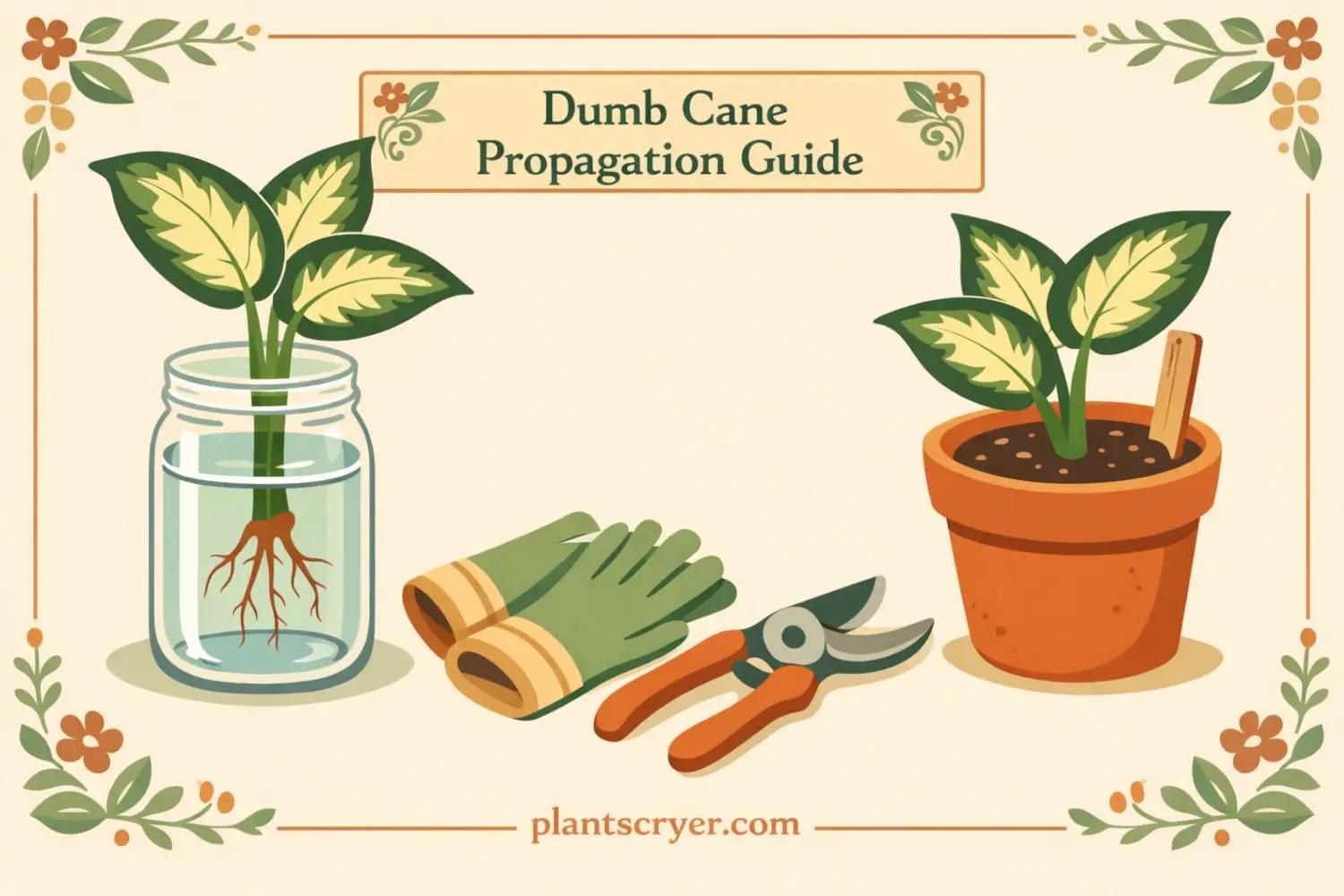
The fix for a leggy cane is not water, it is a cut. Dieffenbachia regrows readily from the stem, and the cut section roots in water, which is covered in the propagation guide. Cut above a node, keep the sap off your hands, and you get two plants out of one bare stem.
More dieffenbachia guides
Frequently Asked Questions
Every 7 to 14 days during the growing season, depending on pot size, material, and light level. Check the top one to two inches of soil before watering: if it's still damp, wait.
Push your finger into the top one to two inches of soil. If it feels dry at that depth, water thoroughly until it drains from the bottom. If it still feels damp, wait a few more days.
Drooping is usually a sign of underwatering. Check the soil. If it's dry, water it and the plant will typically recover within a few hours. If the soil is wet and the plant is drooping, overwatering and possible root rot is the more likely cause.
Yes. Growth slows in autumn and winter so the plant uses less water. Extend your watering interval to roughly every 12 to 18 days, but don't let the soil dry out completely. Dieffenbachia doesn't go fully dormant the way succulents do.
Yes. Dieffenbachia is sensitive to fluoride and chlorine in tap water. Leaving tap water to sit overnight allows chlorine to dissipate, though fluoride stays. A filtered water pitcher is the more reliable fix.