How to Care for a Chinese Money Plant
Pilea peperomioides
Nearly every Chinese money plant in Europe and North America traces back to one man’s luggage. The University of California records that the Scottish botanist George Forrest collected the species in Yunnan in 1906 and again in 1910, after which it effectively vanished from Western horticulture, and that it was found again by the Norwegian missionary Agnar Espegren, who brought his cuttings back to Norway by way of India in 1946.
From there it spread through Scandinavia, hand to hand, long before it was widely sold. This is the original pass-along plant, and the reason it appeared in Western shops so suddenly in the 2010s is that it had been circulating privately for seventy years.
It is also a nettle. Pilea peperomioides belongs to Urticaceae, the nettle family, and has no sting and no irritant sap whatever, so the relationship is a piece of trivia and not a warning. The species name points at a different plant again: peperomioides means Peperomia-like, after the resemblance to plants such as the baby rubber plant, a species in a completely separate family.
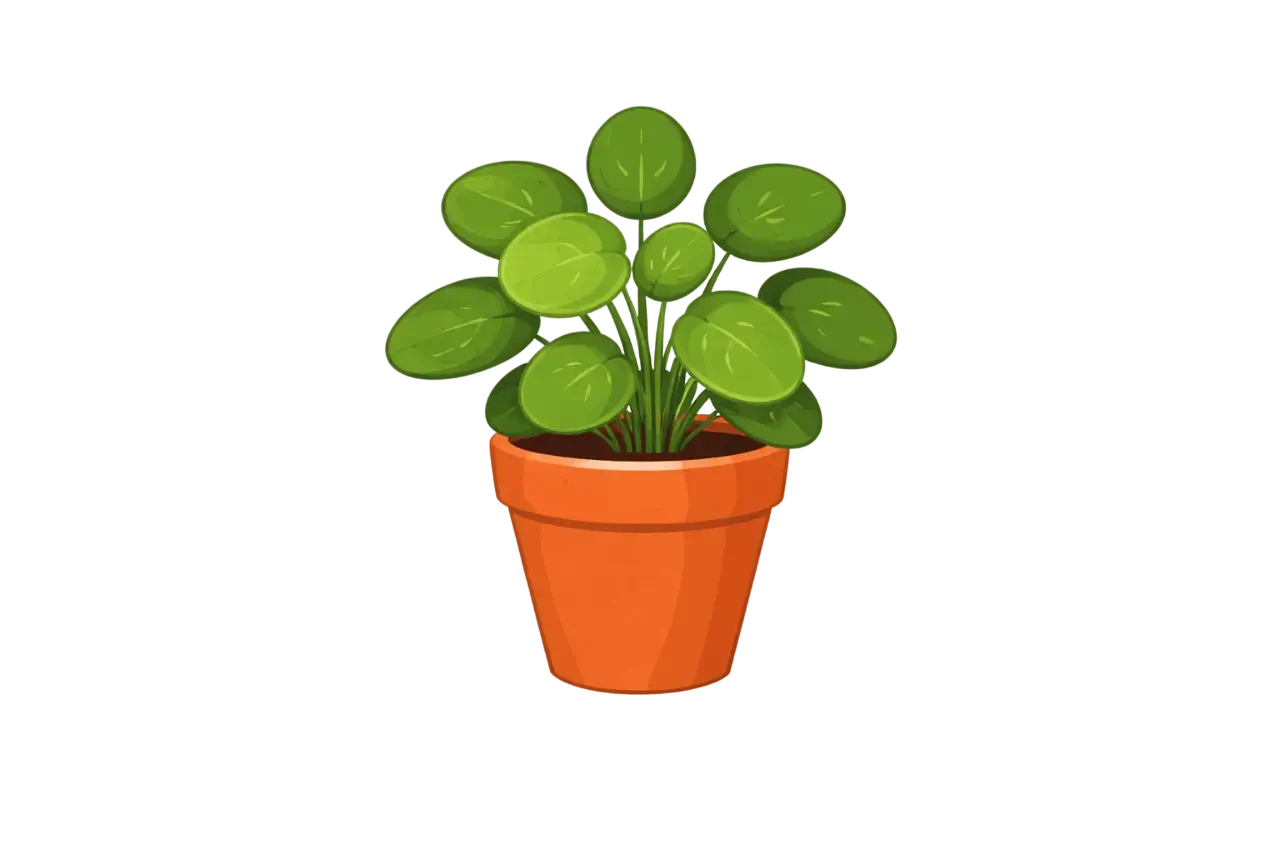
The leaves are the whole point and the botanical term for them is worth knowing, because it explains the look. NC State describes them as round, peltate, fleshy and dark green, up to 4 inches across, with the long stems attaching at the centre of the leaf. Peltate means exactly that centre attachment, like a parasol instead of a conventional leaf on a stalk at its edge, and it is why the leaves read as floating coins instead of foliage.
Its habitat explains the care. NC State places it in Yunnan Province in southern China, in shady and cool mountain areas, a long way from the hot bright conditions people often assume for a plant with fleshy leaves. Bright indirect light, moderate warmth and steady moisture is the brief. NC State also rates the growth rate rapid and lists the plant as safe for pets and children, so it is both quick to establish and uncomplicated to live with.
Quick Info
- LightMedium
- WaterMedium
- Size8-12 inches tall and wide
- HumidityModerate
- Temp60-80°F (16-27°C); no frost tolerance
- FloweringYes
- TypeTropical
- Dog SafeYes
- Cat SafeYes
- Kid SafeYes
Is Chinese Money Plant Toxic to Pets?
Pets: NC State lists Pilea peperomioides as safe for pets and children, and no toxic principle is recorded for it. Despite sitting in the nettle family it has no sting and no irritant sap, which makes it one of the few plants you can put at floor level without a second thought.
Kids: NC State rates it safe for children. The leaves detach easily if pulled, so the plant is more at risk from a toddler than the reverse.
Chinese Money Plant Care Guide
Light, and Keeping the Leaves Flat
Bright indirect light, or dappled sun, or partial shade at two to six hours of direct light: NC State lists all three. The habitat is shady mountain forest, so filtered light, not full exposure, is what the plant is built for. An east window is close to ideal, and a position a couple of feet back from a south or west one works well.
Direct midday sun through glass scorches the leaves and bleaches the dark green. Too little light produces the opposite problem, which on this plant shows as long bare stems with the leaves spaced far apart and the whole thing leaning hard toward the window. Rotating the pot every week or two keeps it growing evenly, since the leaves orient to the light source quite strongly.
Watering, and Off the Foliage
NC State asks for a moist, well-drained potting mix and flags the plant as susceptible to root rot if overwatered. So the target is evenly damp with the top inch allowed to dry between waterings, never waterlogged. The fleshy leaves and stems hold a little water, which gives you a small margin at the dry end. A moisture meter settles it if the pot is a deep one.
Water the compost and keep it off the foliage. NC State lists leaf spots from wet foliage among the problems, and the way the stalks join in a crowded crown means water sitting there drains slowly. Drooping is the first sign of trouble in either direction, so feel the compost before deciding what it means. Recovering an overwatered plant covers the wet end.
Mix, Balance and Repotting
Loam or sand with good drainage at an acid to neutral pH below 8.0, which is NC State’s description. An ordinary houseplant compost with perlite stirred through covers it, and the extra drainage is worth having on a plant explicitly flagged for root rot.
Think about weight and balance. A mature pilea carries its leaves out on long stalks from a narrow base, so a tall plant in a light pot is easy to knock over and the stalks snap where they meet the stem. A heavier pot, or at least a wide-based one, saves the shape.
Spring, every year or two, moving up one pot size. A fast grower that is also producing offsets fills a pot quickly, and repotting is the natural moment to separate the pups, which is covered below. A wide pot suits the plant better than a deep one.
Bury the stem no deeper than it was. The crown sits at compost level and the lower stem will rot if you plant it down into damp mix, a real risk when you are tempted to steady a top-heavy plant by potting it deeper. Support it with a wider pot instead.
Humidity, and an Honest Non-Answer
NC State gives a usefully honest answer here: the plant does best in moderate to high humidity, but it is tolerant of the average home’s humidity levels. So humidity helps and is not a requirement, which puts this plant in a different category from a calathea.
No percentage target is published, so there is nothing to aim at. If you already run a humidifier the pilea will benefit, and if you do not, it will be fine. What is worth avoiding is misting, given that NC State names leaf spots from wet foliage as a problem.
Feeding, Monthly and Modest
A balanced liquid feed monthly through spring and summer, nothing over winter. This is a rapid grower by NC State’s rating and it is also producing pups, so it draws on a feed more than a slow plant would.
Do not go above the label dose. Overfeeding lengthens the petioles, and a pilea grown for a tidy mound of coins becomes a loose scatter of them on long stalks instead. That is the fault worth guarding against on this plant.
Temperature, and Cooler Is Safer
Ordinary room temperature, and cooler rather than warmer if you have the choice. NC State records hardiness in USDA zones 9a to 11b, short of any real freeze, and describes the native habitat as cool mountain areas, which suggests the plant is more tolerant of a chilly room than a baking one. No indoor optimum has been published for Pilea peperomioides. Given the mountain origin, erring on the cool side is better supported than erring warm. What to avoid is specific enough: cold draughts, and the hot dry microclimate directly above a radiator, where the leaf edges start to crisp.
Grooming, and the Leggy Stem
There is little to prune beyond taking yellowed lower leaves off where they join the stem, using clean snips. Losing the occasional bottom leaf is normal as the stem lengthens. If the main stem has grown tall and bare, it can be cut back and will branch, and the top becomes a cutting.
Wipe the leaves now and then with a damp cloth. Those flat round surfaces collect dust faster than most foliage and it shows badly on dark green, and the wipe is also when you notice spider mites or scale early. Dry them afterwards instead of leaving them wet.
How to Propagate a Chinese Money Plant
Offsets, or pups, are the whole appeal and the reason this plant travelled the way it did. NC State lists propagation by offsets and by stem cuttings, best done in spring or early summer during active growth. The pups come up from the roots around the base of the parent, and a healthy plant produces them steadily without being asked.
Wait until a pup is a couple of inches tall with a few leaves of its own, then follow its stem down into the compost and cut it away with a clean blade, taking whatever roots have formed. Pot it into the same free-draining mix at the depth it was growing and water sparingly for the first week or two. A pup with roots establishes almost without pause. Pups also appear on the main stem occasionally instead of from the roots, and those can be treated the same way: cut them off flush with a clean blade and root them in damp compost. They have no roots to start with, so keep them somewhere humid and bright until they take hold, and expect a slower start than a rooted offset.
Stem cuttings are the fallback for a plant that has grown tall and bare. Cut the top off above a leaf, root it in water or compost, and the stump will branch from lower down, so you end up with two plants and a better shape. Given how freely this species offsets, most people never need the stem-cutting route at all, and that free supply is how the plant ended up being passed between friends for seventy years before anyone sold it.
Common Chinese Money Plant Problems
Yellowing lower leaves with compost that stays wet is the overwatering signal, and NC State flags this species as susceptible to root rot. Let the top inch dry before watering again and check the pot drains freely. Yellowing on other plants sets out the causes that point elsewhere.
Drooping leaves happen at both ends of the watering range, so it is a poor diagnostic on its own. Feel the compost: dry and drooping means water, wet and drooping means the roots are struggling and more water will make it worse.
Curling or cupping leaves usually follows too much direct sun, sometimes combined with a dry spell. Move the plant out of the beam and keep the watering steady. The affected leaves stay curled, so judge the fix by the new ones.
Long bare stems with the leaves spaced widely apart and the plant leaning is a light problem. Somewhere brighter, out of direct sun, is the answer, plus rotating the pot regularly. Cutting the stem back forces branching if the shape has gone too far.
Pale spots or blotches on the leaves point at the leaf spots NC State attributes to wet foliage. Stop misting, water the compost and not the plant, and take off badly marked leaves.
Small flies around the pot are fungus gnats, which NC State lists for this species alongside spider mites, mealybugs and scale. They are a symptom of compost staying wet at the surface, so they often arrive with the overwatering that threatens the roots. Clearing fungus gnats tackles the damp compost behind them.
Fine stippling or webbing between the leaf stalks is spider mites, which find the crowded crown of a mature pilea convenient cover. Identifying houseplant pests covers telling them from scale and mealybugs.
A plant that has never flowered is not failing. NC State describes small white to pinkish flowers on a tall spike and notes that houseplants rarely flower, so the absence is normal. The leaves are the reason to grow it.
FAQs
Yunnan Province in southern China, where NC State records it growing in shady and cool mountain areas. The route it took to the West is unusually well documented: the University of California notes that George Forrest collected it in Yunnan in 1906 and 1910, after which it dropped out of Western horticulture, and that the Norwegian missionary Agnar Espegren brought cuttings back to Norway by way of India in 1946, from where it spread through Scandinavia by being passed between growers.
Yes. NC State lists Pilea peperomioides as safe for pets and children, and no toxic principle is recorded for it. It sits in Urticaceae, the nettle family, which sounds alarming and is not: the plant has no sting and no irritant sap. The only real caution runs the other way, since the leaves detach easily if they are pulled.
Separate the pups. NC State lists offsets and stem cuttings as the methods, best in spring or early summer. Wait until an offset is a couple of inches tall with its own leaves, trace its stem down into the compost, and cut it away with whatever roots it has formed, then pot it at the same depth in free-draining mix. A rooted pup barely checks at all. Pups on the main stem work too but need humidity while they root.
Some of it is normal, since the stem lengthens and the oldest leaves at the base are shed as it does. What is not normal is several going at once on compost that stays wet, which points at the root rot NC State flags for this species. Let the top inch dry between waterings and make sure water leaves the pot instead of sitting in a saucer.
Light. The leaves orient strongly toward the brightest source, so a plant in marginal light stretches its stalks, spaces its leaves out and leans hard one way. NC State puts the plant in bright indirect light, dappled sun or partial shade at two to six hours. Move it brighter but out of direct sun, and rotate the pot every week or two so it grows evenly.
NC State gives 8 to 12 inches tall and about the same across, with individual leaves reaching 4 inches in diameter. Growth is rapid, so a small plant fills out quickly, but it is not a species that becomes large. What it does instead is produce offsets, so an old plant tends to become a cluster instead of a single bigger specimen.
It is helpful but not required, and NC State puts it well: the plant does best in moderate to high humidity but is tolerant of the average home’s humidity levels. No percentage target is published, so there is nothing to measure against. Misting is the one thing to skip, since NC State names leaf spots from wet foliage among the problems.
That arrangement is called peltate, and it is what makes the leaves look like coins. NC State describes the leaves as round, peltate and fleshy with the long stems attaching at the centre of the leaf instead of at an edge, like a parasol. It is an unusual leaf form among houseplants and it is the single feature the plant is grown for.