How to Care for Barrel Cactus
Ferocactus spp.
 Save
Save
Barrel cactus (Ferocactus spp.) is one of the longest-lived houseplants you can own. In the wild, specimens survive 50 to 100 years. In a pot on a bright windowsill, a barrel cactus bought today will easily outlast the furniture around it. Growth is slow, roughly half an inch to an inch per year indoors, so it stays a manageable size for decades without needing a bigger pot.
Native to the deserts of the southwestern United States and northern Mexico, these cacti grow in full, unfiltered sun on rocky slopes with almost no organic soil. Indoors they need the brightest spot you have. A south-facing window is ideal. Without enough direct light, barrel cactus develops the single most common indoor problem: it leans toward the window, sometimes dramatically, and eventually topples under its own weight.
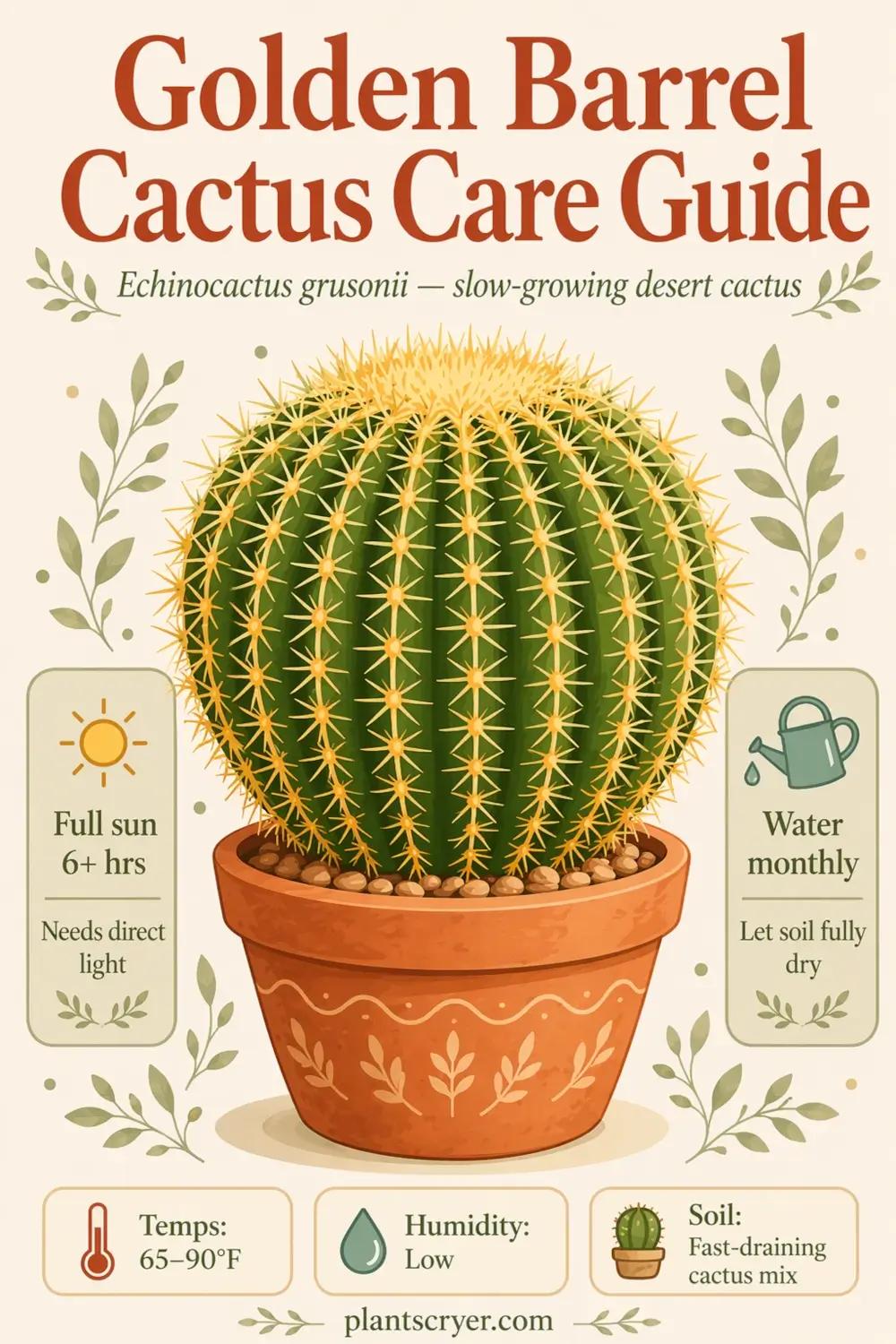
The genus Ferocactus includes about 30 species. The ones most commonly sold as houseplants are Ferocactus glaucescens (blue barrel), Ferocactus wislizenii (fishhook barrel), and Echinocactus grusonii (golden barrel, technically a different genus but sold and cared for the same way). Care is identical across all of them.
Non-toxic to cats, dogs, and humans. The curved spines are the real concern. They are thick, sharp, and hooked on some species, making them difficult to remove from skin or fabric once embedded.
Quick Info
- LightBright
- WaterLow
- Size6 to 12 inches tall indoors; up to 10 feet in the wild
- HumidityLow
- Temp50–95°F (10–35°C)
- FloweringYes
- TypeCactus
- Dog SafeYes
- Cat SafeYes
- Kid SafeYes
Is Barrel Cactus Toxic?
Pets: Non-toxic to cats and dogs. The spines are the hazard. Keep out of reach to prevent puncture injuries. Some species produce sap that can cause mild skin irritation on contact.
Kids: Non-toxic. Spines can cause painful puncture wounds. Keep out of reach of children.
Barrel Cactus Care Guide
Light
Full direct sun. Barrel cactus needs at least 6 hours of direct sunlight daily, and more is better. A south-facing window is the best indoor position. West-facing works if the plant gets strong afternoon light. East-facing windows rarely provide enough intensity to keep the plant growing evenly.
Insufficient light causes leaning. Barrel cactus grows toward the strongest light source, and in a window that lights the plant from one side, the growth tilts noticeably within months. Rotate the pot a quarter turn every 2 weeks to keep growth even. This is the single most important care habit for indoor barrel cactus. If you forget everything else on this page, remember the rotation. A grow light above the plant eliminates the leaning problem entirely by providing even overhead light.
Watering
Very little. Water thoroughly when the soil is completely dry all the way through, then do not water again until it dries out completely once more. During the growing season (spring through early fall) this is roughly once every 2 to 4 weeks depending on pot size, light, and temperature. In winter, once a month at most. Some growers skip watering entirely from November through February.
Barrel cactus stores a large volume of water in its thick body. It can go months without watering and show no distress. Overwatering, on the other hand, rots the roots and base within days. If you are unsure whether to water, do not water. A moisture meter is helpful for confirming the soil is dry at the bottom of the pot before you add water.
Soil
Fast-draining, mineral-heavy mix. A cactus and succulent potting mix is the base. For barrel cactus, add extra perlite, pumice, or coarse sand until the mix is at least 50% mineral grit. In the wild, these plants grow in rocky, almost soil-free terrain. The potting mix should drain within seconds of watering. Standard potting soil will kill this plant. Use a terracotta pot with a drainage hole; the porous clay wicks excess moisture away from the roots.
Temperature
50 to 95°F (10 to 35°C). Handles heat well and tolerates up to 100°F+ without complaint. Keep above 50°F at all times; most Ferocactus species are not frost-hardy. For blooming, provide a winter cool period of 50 to 55°F for 6 to 8 weeks. An unheated room that stays above freezing works. Without this cool period the plant grows fine but is less likely to flower. Normal indoor humidity is fine; no misting needed.
Fertilizing
Minimal. Apply a succulent fertilizer diluted to quarter strength once every 4 to 6 weeks during spring and summer. A low-nitrogen formula (like 5-10-10 or a dedicated cactus feed) is better than balanced formulas, which push soft growth on a plant that should be growing dense and slow. Stop fertilizing entirely from October through February. Over-fertilizing causes salt buildup in the pot that damages roots.
Repotting
Every 2 to 3 years, or when the cactus has visibly outgrown the pot. Use a pot only 1 inch wider than the plant body. Barrel cactus has a small root system for its size and does not need much room. Oversized pots hold excess moisture around the roots. Wrap the cactus in several layers of newspaper or towel to handle it. Use thick leather gloves. The curved spines are difficult to extract from skin and fabric once they snag. Wait 3 to 5 days after repotting before watering.
Propagation
Seed only for most species. Barrel cactus is a solitary grower and does not produce offsets or pups (with rare exceptions in a few species like Ferocactus robustus). Seeds germinate in 1 to 4 weeks when kept warm (75 to 85°F) and lightly moist on the surface of a sandy mix. Growth is extremely slow in the first few years, typically less than half an inch per year. Most growers buy established plants rather than starting from seed.
Common Barrel Cactus Problems
Leaning toward the window The most common indoor barrel cactus problem. The plant grows toward the strongest light source, and one-sided window light causes a permanent lean over time. Rotate the pot a quarter turn every 2 weeks. If the lean is already significant, rotate it so the leaning side faces away from the window and let the plant self-correct over several months. A severe lean that has progressed to the point of instability may need staking while it straightens.
Root rot Soft, discoloured base tissue with brown or black mushy roots. Caused by overwatering, soil that holds too much moisture, or a pot without drainage. If caught early (only the lowest roots affected), trim the rot, let the base callus for several days, and replant in dry mineral-heavy cactus mix. If the rot has reached the body of the cactus, the plant is usually not salvageable. Root rot vs soil mold covers how to tell the two apart.
Scarring or corking at the base A hard, brownish woody texture on the lower portion of the cactus is corking, a natural ageing process. It is structural, not disease. The area will be firm and dry, not soft or mushy. No treatment needed. If the brown area is soft and the tissue gives when pressed, that is rot, not corking.
Elongated or stretched growth New growth that is narrower than the base means the plant is not getting enough light. Barrel cactus should maintain a consistent diameter as it grows taller (or get wider). Narrowing at the top is etiolation. Move to a brighter spot. The stretched portion is permanent but new growth will resume the correct diameter.
Scale insects Flat, brown or tan bumps on the cactus body between the ribs. Scale feed on sap and cause slow decline if left unchecked. Scrape off with a toothpick or cotton swab dipped in rubbing alcohol. For larger infestations, neem oil applied between the ribs helps, but be careful not to apply in direct sun as it can cause burns on the cactus surface.
FAQs
Every 2 to 4 weeks during spring and summer, once a month or less in winter. Let the soil dry out completely between waterings. Barrel cactus stores water in its body and handles drought far better than excess moisture. If in doubt, wait longer. Overwatering is the fastest way to kill this plant.
It is growing toward the strongest light source. Barrel cactus grows directionally toward light, and one-sided window light causes a lean over time. Rotate the pot a quarter turn every 2 weeks to keep growth even. If the lean is already noticeable, face the leaning side away from the window and let it self-correct over several months.
Decades. Wild specimens live 50 to 100 years or more. In a pot with adequate light and minimal watering, a barrel cactus can easily outlive its owner. Growth is slow (about half an inch to an inch per year indoors), so it stays a manageable size for a very long time.
Possible but uncommon. Indoor blooming usually requires a winter cool period of 50 to 55°F for 6 to 8 weeks, mature age (at least 2 to 3 years old, often older), and strong direct light year-round. Flowers appear in late spring to early summer in shades of yellow, orange, or red depending on the species.
Non-toxic to cats, dogs, and humans. The spines are the concern, not toxicity. Some species have hooked spines that are especially difficult to remove from skin. Keep the cactus on a high shelf or stable surface where pets and children cannot bump into it.
Wrap the cactus in several layers of thick newspaper or a folded towel. Use thick leather gloves. Tilt the old pot to slide the cactus out rather than pulling from the top. Place into the new pot, fill around with dry cactus mix, and do not water for 3 to 5 days to let any root disturbance heal.
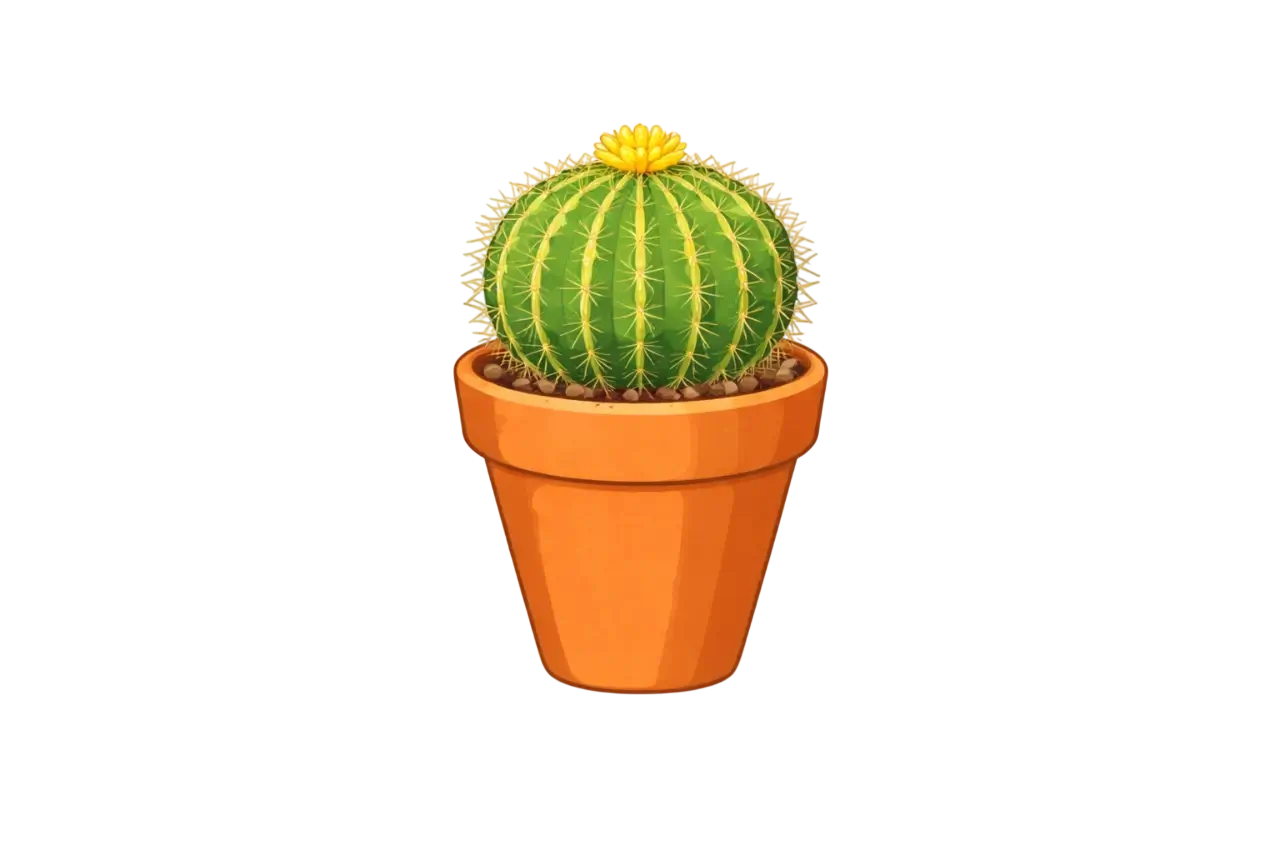
Ferocactus (fishhook barrel, blue barrel) and Echinocactus (golden barrel) are different genera that look similar and are cared for the same way. Ferocactus species typically have hooked or curved spines and grow taller. Echinocactus grusonii (golden barrel) has straighter spines and stays more globular. Both are sold as barrel cactus and the care on this page applies to both.