How to Care for African Violet
Streptocarpus sect. Saintpaulia
 Save
Save
African violets are one of the few houseplants that flower reliably and almost continuously indoors. With the right light schedule, a single plant can bloom several times a year, producing clusters of purple, pink, blue, white, or bicolour flowers above a neat rosette of fuzzy, rounded leaves. They have been the most popular flowering houseplant in the United States for decades, and collections of hundreds of named cultivars exist.
Originally classified as Saintpaulia ionantha, African violets were reclassified into Streptocarpus sect. Saintpaulia in 2015. The old name persists on most plant labels and care guides. Native to the cloud forests of the Usambara Mountains in Tanzania, these plants grow on mossy rocks and forest floors in filtered light and consistent humidity. That origin explains their two biggest indoor sensitivities: they need steady, gentle light (never direct sun) and they hate cold water on their leaves.
The care is specific but not difficult once you know the rules. Bottom watering (not top watering), room-temperature water (never cold), 14 or more hours of light for blooming, and a small pot relative to the plant size. Break any of those rules consistently and the plant shows it: ring spots from cold water, crown rot from water pooling in the centre, no flowers from insufficient light hours, or root rot from an oversized pot.
Non-toxic to cats, dogs, and horses per ASPCA. One of the safest flowering houseplants for pet homes.
Quick Info
- LightMedium
- WaterMedium
- Size4 to 8 inches tall, 6 to 16 inches wide
- HumidityModerate
- Temp60–80°F (16–27°C)
- FloweringYes
- TypeTropical
- Dog SafeYes
- Cat SafeYes
- Kid SafeYes
Is African Violet Toxic?
Pets: Non-toxic to cats, dogs, and horses per ASPCA. One of the safest flowering houseplants for pet households. Chemical treatments (pesticides, systemic insecticides) applied by growers may be present on new purchases.
Kids: Non-toxic. Safe around children.
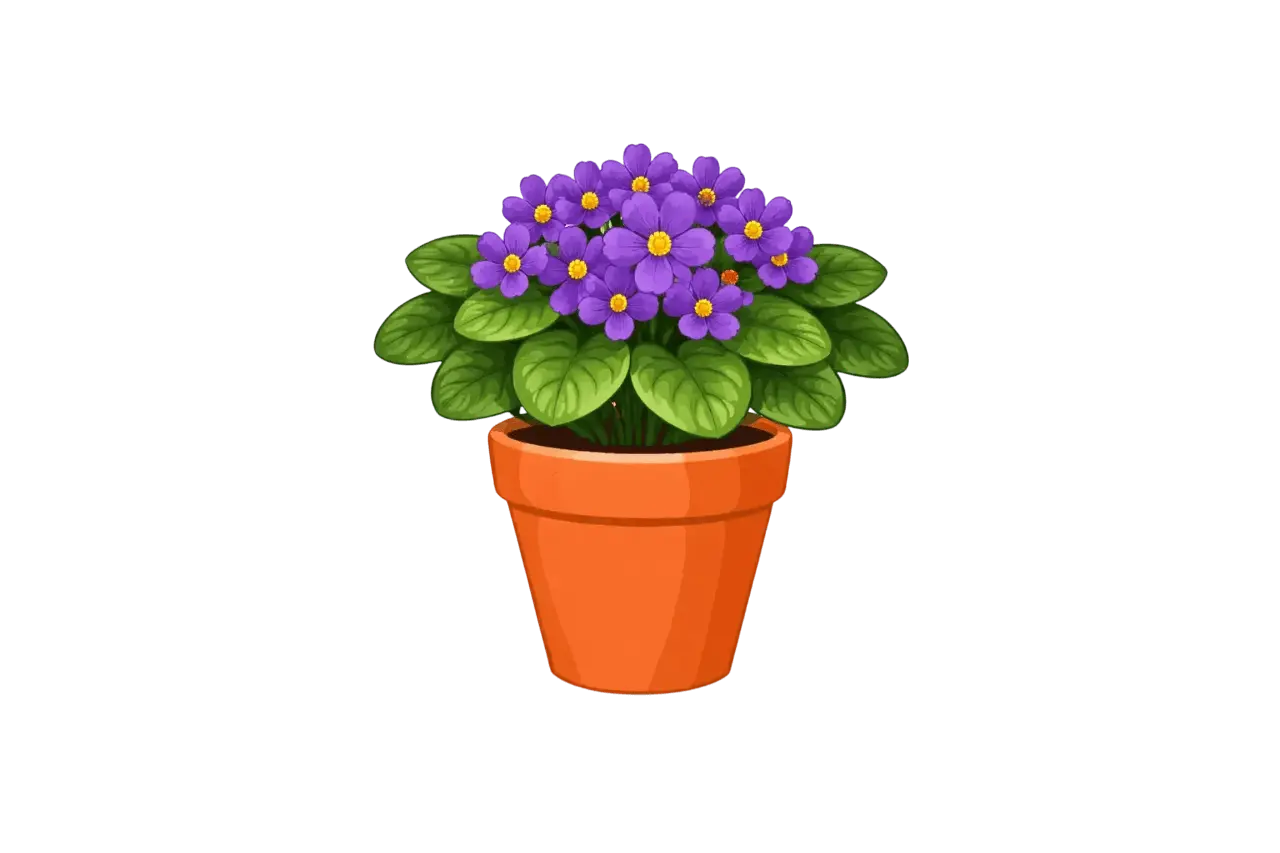
African Violet Care Guide
Light
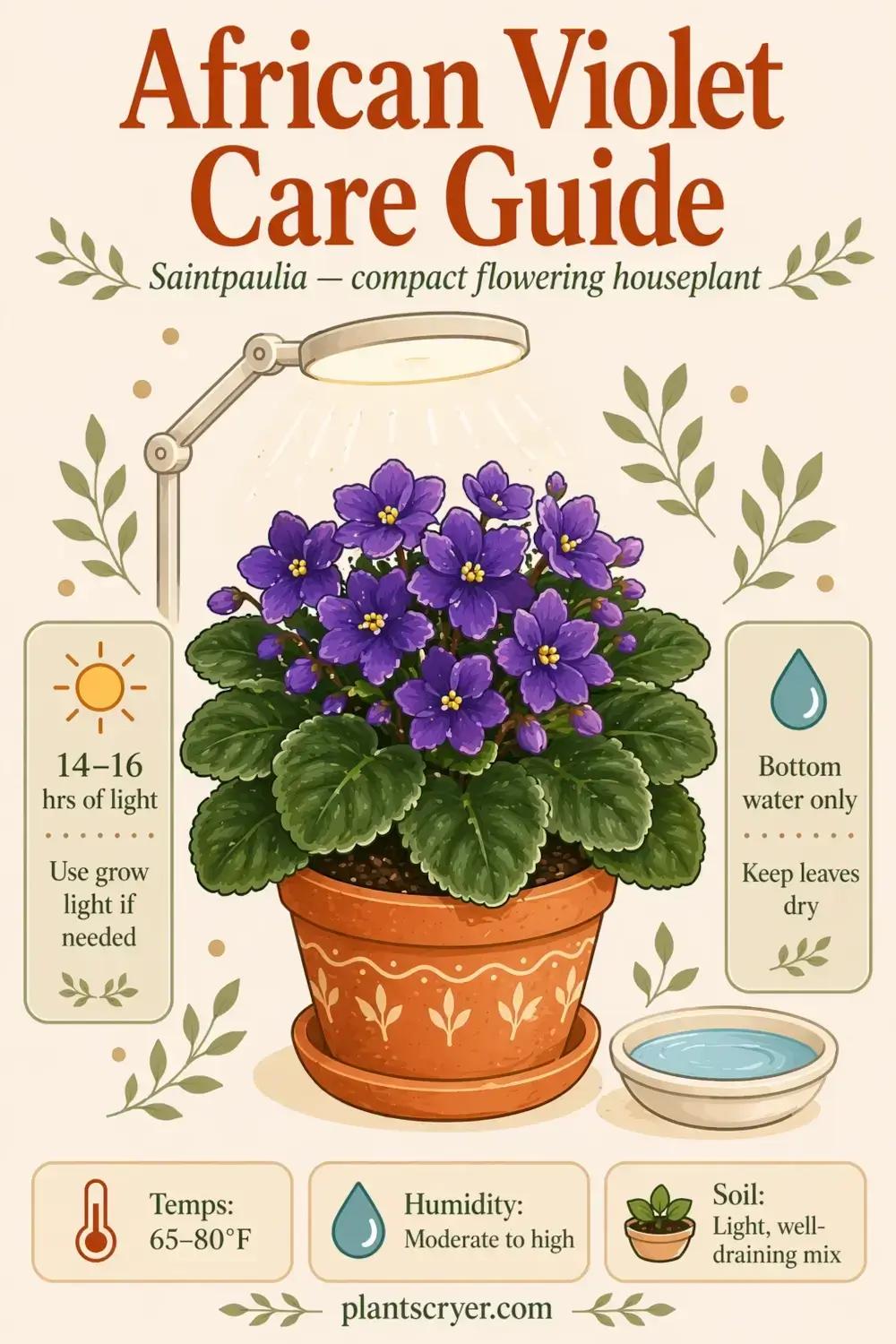
Bright indirect light, no direct sun. An east- or north-facing window is ideal. African violets burn in direct sun (the leaves scorch and bleach), but they need 14 to 16 hours of light daily to bloom consistently. That is more hours than any window provides in winter at most latitudes, which is why so many African violets stop flowering from November through February.
A grow light on a timer is the most reliable way to get year-round blooms. Set it for 14 to 16 hours on, 8 to 10 hours off. Position the light 10 to 12 inches above the plant. If the leaves start to curl downward and bleach, the light is too close or too intense. If the plant produces healthy leaves but no flowers, it is not getting enough total light hours.
Watering
Bottom water. Set the pot in a saucer of room-temperature water for 20 to 30 minutes and let the soil wick the moisture up through the drainage holes. Remove the pot from the saucer afterward. This is the safest watering method for African violets because it keeps water off the leaves and out of the crown, where it causes rot and permanent leaf spots.
The water temperature matters. Cold water on the leaves causes ring-shaped white or yellow spots that do not heal. Always use room-temperature water (roughly 70°F). Let the top half inch of soil dry between waterings. Overwatering is the most common cause of death; the small root system rots fast in soggy soil. A moisture meter helps confirm the soil is dry before you water again.
Soil
Light, soilless, peat-based mix with excellent drainage. A dedicated African violet potting mix works, or you can blend 50% peat-based potting mix with 50% perlite. The mix should feel light and fluffy, never dense or heavy. pH should be slightly acidic (6.0 to 6.5). African violets have small, fine root systems that suffocate in dense soil. Repot into fresh mix annually; old mix breaks down, compacts, and holds too much water.
Temperature and Humidity
60 to 80°F (16 to 27°C), with 70°F being the sweet spot. Below 60°F growth stalls and the plant becomes susceptible to crown rot. Avoid cold drafts and cold windowsills in winter. Consistent temperature matters more than the exact number; sudden swings stress the plant and can cause bud drop.
Humidity of 40 to 60%. In dry winter air, place the pot on a pebble tray with water (the pot sits on the pebbles above the water line, not in the water). Do not mist the leaves. Water droplets on the fuzzy leaves cause spots and promote fungal disease. A humidifier nearby raises humidity without wetting the foliage. Good air circulation prevents fungal problems but avoid direct drafts.
Fertilizing
Feed lightly with every watering. Use a balanced liquid fertilizer diluted to one-quarter strength with each watering rather than full strength monthly. This "weakly, weekly" approach provides a steady nutrient supply that matches the plant's continuous growth and flowering cycle. A higher-phosphorus formula (like 12-36-14) encourages more blooms. Flush the soil monthly with plain water to prevent salt buildup, which burns the fine roots.
Repotting
Annually, in fresh mix. African violets do best in pots that are one-third the diameter of the leaf spread. A plant with a 12-inch leaf spread goes in a 4-inch pot. Oversized pots hold excess moisture around roots that cannot use it, leading to rot. When repotting, remove the plant, shake off old mix, and pot into fresh mix. If the stem (neck) has elongated above the soil line, bury it up to the lowest ring of healthy leaves. This re-roots the plant and rejuvenates it. Use pots with drainage holes; self-watering pots with a reservoir work well for African violets.
Propagation
Leaf cuttings: Cut a healthy leaf with 1 to 2 inches of stem attached. Insert the stem at a 45-degree angle into moist, light potting mix (50/50 peat and perlite). Cover loosely with a clear plastic bag or dome to hold humidity. Keep in bright indirect light. Baby plantlets appear at the base of the leaf in 4 to 8 weeks. Once the plantlets have 3 to 4 leaves of their own, separate and pot individually. A single leaf can produce multiple plantlets.
Division: Mature African violets sometimes produce side crowns (suckers) at the base. These can be carefully separated from the main plant during repotting and potted individually. Each division needs its own root system to survive. Remove suckers when small to prevent the main crown from losing its symmetry.
Common African Violet Problems
Not blooming Insufficient light hours is the most common cause. African violets need 14 to 16 hours of light daily to bloom. Most windows provide far less than this in winter. Add a grow light on a timer. If light is adequate, check fertilizer (a phosphorus-heavy formula encourages blooms) and pot size (a pot too large diverts energy to roots instead of flowers).
Ring spots on leaves Caused by cold water touching the leaves. The temperature difference between the cold water and the warm leaf tissue damages the cells, leaving permanent white or yellow ring marks. Prevent by bottom watering with room-temperature water. Spotted leaves will not heal but new leaves will grow in clean.
Crown rot Mushy, water-soaked centre of the plant. Caused by water pooling in the crown or chronically wet soil. The crown turns brown and collapses. If caught very early, remove all rotted tissue and repot in dry fresh mix. In most cases, crown rot is fatal once it reaches the main stem. Prevention: bottom water only, never let water sit in the crown, and ensure the pot is not oversized.
Leggy neck (elongated stem) Over time, the lower leaves die and the stem (neck) elongates above the soil line. This is normal aging. Fix by repotting deeper: remove the plant, scrape the exposed neck gently, and bury it up to the lowest ring of healthy leaves in fresh mix. New roots will form along the buried neck.
Powdery mildew White, powdery coating on leaves and flowers. Caused by poor air circulation combined with high humidity. Improve airflow around the plant (a small fan on low nearby helps). Remove affected leaves. Treat with a fungicide if needed. Do not mist; it makes the problem worse.
Mealybugs and cyclamen mites Mealybugs appear as white cottony clusters in leaf axils. Cyclamen mites are too small to see but cause stunted, distorted centre growth and failure to bloom. Treat mealybugs with rubbing alcohol on a cotton swab. Cyclamen mites require a miticide or hot water treatment (immerse the entire plant in 110°F water for 15 minutes). Isolate any infected plant immediately.
FAQs
Light is the main factor. African violets need 14 to 16 hours of light daily to flower. Most windows do not provide this, especially in winter. A grow light on a timer (14 hours on, 10 hours off) positioned 10 to 12 inches above the plant is the most reliable solution. Also feed with a higher-phosphorus fertilizer and keep the pot small relative to the plant.
Cold water touching the leaves. The temperature difference between cold water and warm leaf tissue damages the cells, leaving permanent white or yellow ring marks. Always use room-temperature water (roughly 70°F) and bottom water to keep the leaves dry. Spotted leaves will not heal but new growth comes in clean.
Bottom watering is safer. Set the pot in a saucer of room-temperature water for 20 to 30 minutes and let the soil wick it up. Remove the pot afterward. This keeps water off the leaves (which causes spots) and out of the crown (which causes rot). Top watering works if you use a narrow-spout watering can and avoid the foliage, but bottom watering removes the risk entirely.
No. African violet is non-toxic to cats, dogs, and horses per ASPCA. It is one of the safest flowering houseplants for pet households. Chemical treatments (pesticides, fertilizers) applied by the grower may be present on new purchases, so rinse the pot and check the soil before allowing pet access.
Small. The pot diameter should be one-third the width of the leaf spread. A plant with a 12-inch spread goes in a 4-inch pot. Oversized pots hold excess moisture that the small root system cannot use, leading to root rot. African violets bloom better in snug pots.
Leaf cuttings are the standard method. Cut a healthy leaf with 1 to 2 inches of stem, insert at a 45-degree angle into moist peat/perlite mix, and cover with a humidity dome. Baby plantlets appear in 4 to 8 weeks. A single leaf can produce multiple new plants. Separate when the plantlets have 3 to 4 leaves.
Normal aging. The lower leaves die over time and the stem (neck) elongates above the soil. Fix by repotting deeper: remove the plant, gently scrape the exposed neck, and bury it up to the lowest ring of healthy leaves in fresh mix. New roots form along the buried neck. Do this annually during your regular repot.